My next piece is a long one and a little closer to home (metaphorically, if not literally). It is about my granny Dina’s grandmother, Jeanie McLean and is the story of how (and perhaps why) she took all of her family from Scotland to New Zealand, except for her eldest daughter Mary (Dina’s mum). We are very lucky to have an audio recording of Mary talking with Dina and her son Martin about her life – something which inspired me to record my granny in a similar way. I have drawn on both of these recordings, amongst many other family and documentary sources, for this biography of Jeanie and there is a short extract from the recording of Mary included within the story. I have tried to remain relatively objective when describing what happened, but with only a first-hand account of one side of the story there may well be an element of bias. Although I got some information from Jeanie’s grandson Lyall years ago, I now regret not speaking more to him before his death in 2013. Perhaps one day I’ll unearth more details from my remaining distant cousins in New Zealand.
(From now on I will include a short intro like this in these blog posts and link to the full story on a separate page. Hopefully that will make the site a little less cluttered going forwards)
Charles Eastoe sat in his daughter Gerty’s house on Nile Street in the winter of 19211, two years after Eliza’s death and two years before his own. At eighty-three, his once-sturdy frame had grown stooped with age, but his full white beard and flat cap gave him the dignified appearance of a man who had weathered life’s storms. The former farm labourer was now dependent on his youngest daughter’s care – a modest but secure end to lives that had begun in hardship and uncertainty. The story of how Charles and Eliza built their remarkable family legacy began six decades earlier, in the small Norfolk village of Litcham, where two people marked by loss would find each other and create something enduring.
Two Lives Shaped by Hardship
Charles had been born in Litcham around 1838, the sixth child of Henry and Mary Eastoe2. His father worked as a labourer, and the family lived the precarious existence common to agricultural workers of the time. By 1841, nine people crowded into the cottage on Bridge Street3. Litcham in Charles’s youth was described as “the principal trading Town for the surrounding agricultural Villages4.” In 1831 the population was 771 and most people were involved in agriculture. The village attracted families because of “the uninclosed Commons or Waste Lands” – common lands that provided opportunities for the poorest residents to graze animals or gather resources. The 1851 census found the family on Back Lane, with Charles and his brother working as “farmer’s boys” while their father continued as an agricultural labourer5. It was a life of limited prospects, where young men might expect to follow their fathers into the same cycle of seasonal work and economic uncertainty.
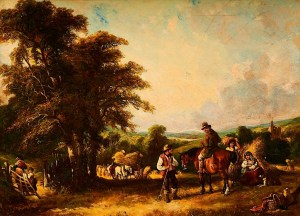
Haymaking Scene with Farm Labourers – Norfolk School, circa 1840
Eliza Pratt’s childhood in Norwich had been marked by different but equally challenging circumstances. Born in 18406 to Joseph, a weaver, and Lucy, she lived in Wales Buildings7 and later Barnes Yard in the parish of St. Augustine. Barnes Yard and Wales Buildings were part of Norwich’s poorest neighbourhoods, where desperation was never far beneath the surface. In 1847, around the time Eliza and her mother were living as paupers in Barnes Yard, a dead infant was discovered in a bin there8. The area had also witnessed political ferment: on New Year’s Day 1841, when Eliza was just a baby, a parade of 400-500 Chartists marched past Wales Buildings9. By 1851, Eliza’s father had abandoned the family. The census recorded Lucy and her daughter as paupers in Barnes Yard10, while Joseph was living elsewhere with an unmarried woman and child11 – a scandalous arrangement that would have brought shame on the family and left them in desperate straits.
Eliza’s response to these circumstances showed early signs of the resilience that would characterize her life. By 1861, she had found work as a servant to a picture dealer in Norwich12, escaping the poverty that had trapped her mother and deaf sister. When Samuel Youell, who had been a lodger with the family13, married her mother in February 186114, it seemed stability might return to their lives. But Youell’s death in early 186215 left Eliza once again facing an uncertain future.
Loss and New Beginnings
Charles’s early adult life was marked by tragedy that would have broken many men. His first marriage, to Eliza Emerson in Snettisham in October 185916, produced at least three children, but none survived infancy. An unnamed daughter died in 1859, baby Henry died in February 1861, and Marianne (recorded as Eliza at her burial) died in September 186217. Three months later, in December 1862, Charles buried his wife as well18. Local reports from this period reveal a man struggling with grief and alcohol. In 1860, Charles and four other Litcham men – labourers George Fulcher and James Butcher, basketmaker John Secker, and tailor George Catton – were fined for being drunk and disorderly19. The incident involved a cross-section of the village’s working men, reflecting the role of public houses as social centres where agricultural workers sought respite from their harsh lives. It’s reasonable to assume that the death of his children and wife would have driven Charles to drink more heavily, though the records don’t explicitly make this connection.
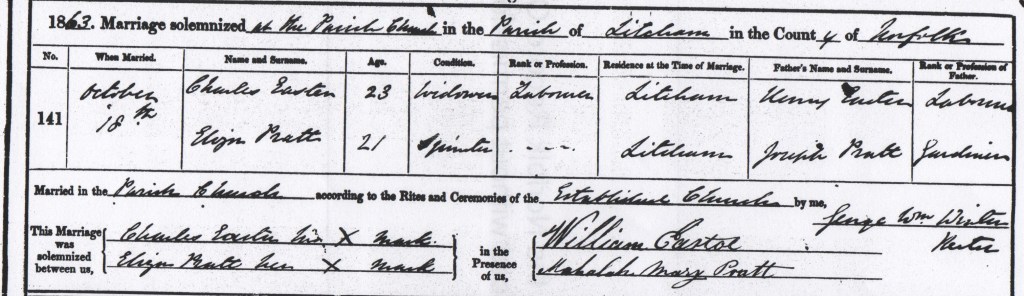
How Charles and Eliza met is not recorded, but the timing suggests her move to Litcham was prompted by Samuel Youell’s death and her need for new employment. Given the limited options for single women and the networks through which domestic work was found, she may have heard of opportunities in the village or known someone who could provide a reference. By October 1863, both were listed as residents of Litcham when they married at All Saints’ Church20.
Marriage register entry of Charles Eastoe/Easter and Eliza Pratt
Building a Family
The early years of their marriage showed Charles continuing to struggle with alcohol while they worked to establish their household. In 1870, he appeared before the magistrate again, this time with his brother Henry Eastoe and Henry Barker, charged with being drunk and refusing to leave the Bull Inn21. The presence of his brother suggests these incidents were part of a pattern of communal drinking among the Eastoe men. Perhaps not surprising given the common hardships of rural life and the desire to escape from gruelling work. Three years later, Charles was fined again for drunkenness, this time with Charles Codling, a fellow labourer ten years his junior. The age gap between Charles and Codling, and their shared work, points to a possible mentor-apprentice relationship, with the older man perhaps introducing the younger to both work and the social life of the village22. This 1873 incident was the last recorded instance of Charles’s drinking problems – suggesting that by his mid-thirties, he had either overcome his difficulties or learned to avoid the attention of the law.
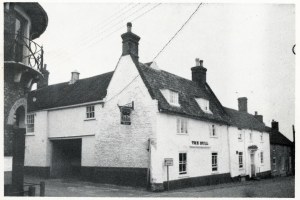
The Bull Inn, Litcham
Despite these troubles, Charles and Eliza’s family grew steadily. Margaret was born in 186423, followed by a brief period when the family moved to Enfield, Middlesex, where Mahala Mary was born in 186624. Charles’s occupation during this time was listed as “groom to a jobmaster” – skilled work caring for horses hired out for transport. Enfield in 1866 was a market town about ten miles north of London experiencing significant growth due to improved transport links. The traffic was so extensive that on one morning alone 2,200 horses were counted on the road between Shoreditch and Enfield, making it ideal for jobmasters and their skilled employees25. The move to Enfield suggests Charles was willing to take risks for better opportunities, though the family’s return to Norfolk by 1867 indicates the venture was short-lived.
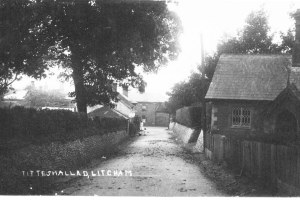
By 1871, the family had settled at 22 Tittleshall Road in Litcham, with Charles working again as an agricultural labourer26. The next 15 years brought many more children: Sarah Anne in 1867, Arthur in 1870, Charles John Henry in 1872, Eliza in 1874, William in 1877, and Alice in 188127. At the time of the 1881 census, the family were at Drury Square on the outskirts of the village with Charles still labouring, the four eldest children at school and the younger two at home with Eliza28.
Tittleshall Road, Litcham
The Move to Norwich
The 1870s and early 1880s were a period of severe agricultural uncertainty in Norfolk and the Norfolk Chronicle documented the crisis facing farm workers29. In 1881, the paper reported a “gloomy harvest” with August bringing “just four inches of rain.” The following year, while 1882 was “above the average standard” for crop yields, the “depreciation of the prices of grain” meant that returns per acre were falling considerably. The summer of 1883 brought its own challenges with a “late harvest” and July being “a decidedly wet month.”
The Eastoe family’s decision to leave Litcham sometime between March 1882 and October 1883 represented a calculated risk. Charles was in his mid-forties with a large family to support, and years of agricultural instability would have made rural labor increasingly precarious. Norwich offered the promise of more diverse employment opportunities and better prospects for their children. The move was likely influenced by family networks – Charles’s nephew Henry was among other family members who had also moved from Litcham to Norwich30, suggesting information about opportunities was shared within the extended family.
Norwich in the 1880s was experiencing urban improvements that would have made it attractive to working families. The city offered more regular employment – no longer dependent on seasonal agricultural work, Charles could find steady work as a general labourer in the city’s growing industries. By October 1883, when George Ernest was born31, the family had settled in Catton, then a village on the northern outskirts of Norwich that offered a compromise between their rural origins and urban opportunities. The move proved successful – their older children were reaching working age, and the city offered opportunities that hadn’t existed in Litcham.
The Next Generation
The 1890s brought evidence of the family’s upward mobility. Now further into the city at Little Wensum Street in Heigham32, their children married and established themselves in skilled trades that represented clear advancement from their parents’ labouring background. Heigham was rapidly becoming a tightly-packed, working class quarter of Norwich filled with small Victorian terraced houses. There, Margaret, a laundress, married a wire weaver and had fifteen children33. Arthur became a shoemaker with ten children34. Charles John Henry remained a labourer but married and had five children35. Eliza became a shoe fitter and married a boot rivetter, having eight children before being widowed young36.
The pattern of mobility continued with the younger children. William (my 2x great grandfather) worked as a labourer, hawker, and eventually opened a fish shop before its bankruptcy in 1905 led him to try mining in Durham37. George Ernest also became a miner, moving to Durham between 1908 and 191138. Alice married a house painter and moved to Middlesbrough around 192039. The fact that three children ventured to the North East for work suggests family networks sharing information about opportunities and an adaptability and resilience passed down from their parents. Family ties were evidently strong though with all eventually returning to Norfolk.
The Final Years
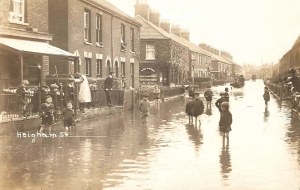
By the early 1900s, Charles and Eliza were living at Haslip’s Opening40 and by 1911 they had achieved modest security as old age pensioners, living next to Margaret’s family in three rooms at 12 Greyhound Opening off Midland Street41. These locations were typical of Norwich’s working-class neighbourhoods – an “opening” being a narrow passage that provided access to rows of workers’ tenements. They were typically small with limited space and shared facilities. Contemporary newspaper reports from the area frequently featured cases of theft, drunkenness, assault, and public disorder, reflecting the harsh realities of life in cramped quarters42. Despite these hardships, such communities were often close-knit, with neighbours supporting each other in daily life. For Charles and Eliza, now in their seventies, their ability to maintain their modest household represented a form of security that many of their neighbours lacked.
Heigham Street, Norwich during flood of 1912
Eliza died in 1920 at age seventy-nine from heart failure43. Charles survived her by three years, spending his final time with Gertrude’s family on Nile Street. When he died in April 1923 at the workhouse infirmary on Bowthorpe Road (now part of Norwich Community Hospital), his death certificate listed him as a farm labourer with senile decay44. He was eighty-five years old.
The Enduring Legacy
The true measure of Charles and Eliza’s success lay in the family they had built. Their ten surviving children produced at least sixty-five grandchildren, creating a network that stretched across England while remaining rooted in Norfolk values. The progression from agricultural labourer to skilled tradesman, from rural poverty to urban respectability, represented the gradual advancement that characterized many working-class families during the Victorian era. Starting with loss and hardship, they had created a family legacy that would endure for generations, proving that even the most humble beginnings need not define the final outcome.
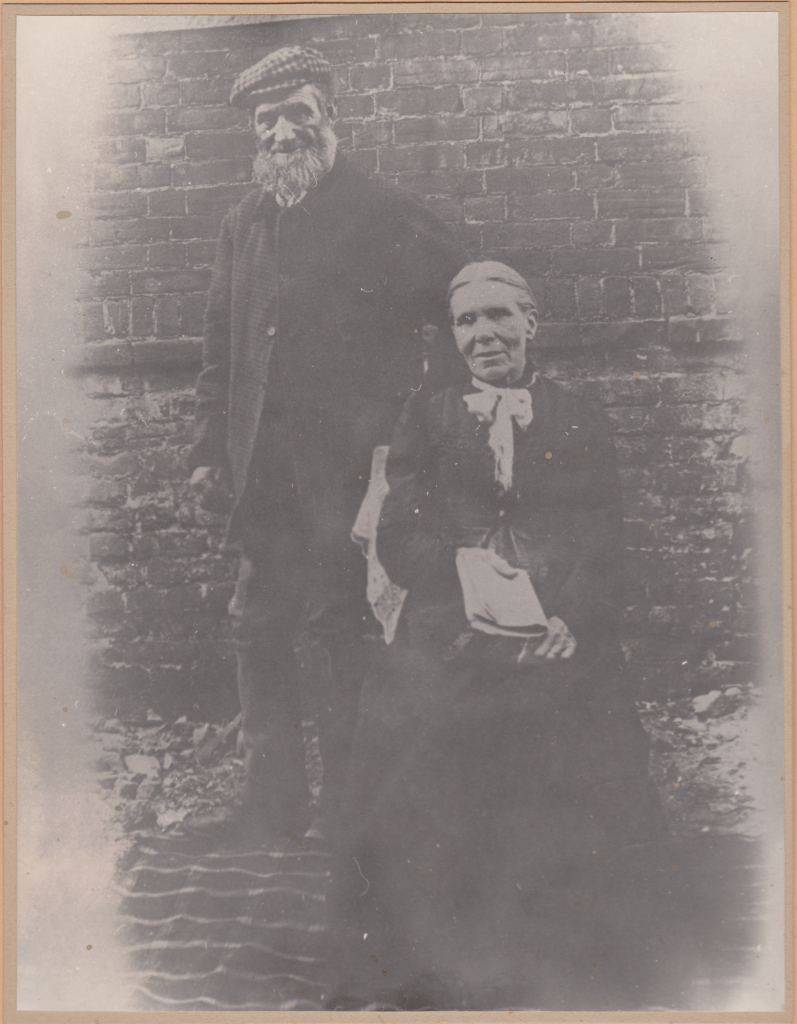
The photograph that survived them – Charles standing behind Eliza in their later years, both dignified and composed against a brick wall – likely captures them in their Norwich neighbourhood during the 1910s, when they would have been in their seventies.
References
1921 Census of England and Wales, Norfolk, Norwich, Nile Street, Gertrude Dorrington household ↩
Norfolk, England, Church of England Births and Baptisms, 1813-1919 on Ancestry ↩
1841 Census of England and Wales, Norfolk, Litcham, Bridge Street, Henry Easter household ↩
In the mid-19th century, during the “golden age of English agriculture”, Luke Pearson turned his back on farming and moved to another county to forge a new path. Leaving behind the life he had grown up with, Luke took a risk and – with his wife, Ann Sharman – created a business which his son would one day take over.
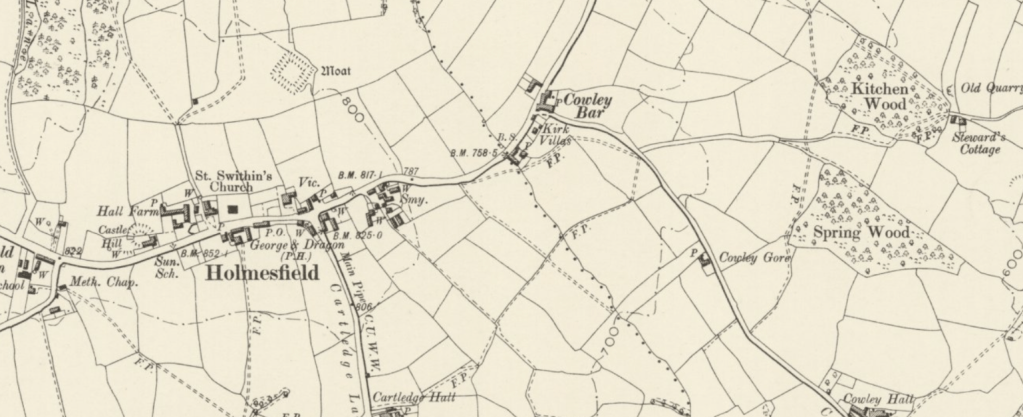
Luke was born in 1818, the tenth child of John and Mary Pearson[1]. By the time he was three, his mother had borne twins both of whom sadly died in infancy[2]. The family lived in the Cordwell Valley, two miles from Holmesfield, in an area known simply as ‘Bank’, rising steeply via Fox Lane. Holmesfield itself was a small village described in one source as being “highly respectable” with “several very genteel habitations”[3]. Nestled on the eastern edge of the Peak District, the area is surrounded by rolling farmland, wooded valleys, and distant moors.
By 1841, the Pearsons were farming in nearby Cowley Gore, with Luke as the only child remaining at home[4]. He worked as a farm servant alongside his father until John’s death in 1845[5]. Luke stayed on to help his widowed mother on the smallholding[6] but after her death in 1854 he began to chart a new course[7]. He became the tenant of Southwood Farm on Hill Top in Dronfield[8], a well-equipped mixed farm with horses, cattle, pigs and even hives of bees. This was not subsistence farming but a relatively comfortable domestic life with a degree of self-sufficiency and modest prosperity.
Yet by his late 30s, Luke remained unmarried and was perhaps restless. His father had fathered eight children by that age; Luke was still turning the soil alone. One can imagine him at the close of a long summer day in 1856, leaning on his plough, watching the sun dip behind Long Acre Wood, wondering if the life he knew was all there was.
View from Hill Top towards Long Acre Wood, photo by Ed Ball
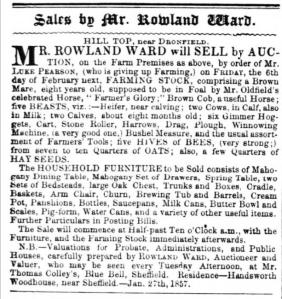
Then in 1857 Luke made a dramatic change[9]: he gave up farming, auctioned off his livestock, equipment and furniture, and moved to Cowley Bar to establish a grocer’s shop.
Notice of auction, Sheffield Independent, 31 Jan 1857
Cowley Bar was a hamlet on a branch of the Sheffield–Derby turnpike, near a tollgate through which coaches and carts frequently passed. The close proximity of the tollgate may have introduced Luke to toll collection as a line of work—an experience that would soon prove relevant. It was also at Cowley Bar that Luke employed a young servant named Ann Sharman[10]. Though not yet married, Luke and Ann’s relationship became strong, and the arrangement suggests a close domestic partnership well before formal vows.
Ann was born in 1833 in Kirklington, Nottinghamshire, the illegitimate daughter of Isabella Sharman of Sutton cum Duckmanton[11]. Her baptism record did not name a father, and she grew up in Edingley, where her mother had married Thomas Foster in 1835[12]. Though she retained the surname Sharman, Ann lived as part of the Foster household, alongside her half-siblings. By 1851, she worked as a framework knitter, a common but gruelling trade in Nottinghamshire, likely taught to her by her stepfather.[13]
In 1850, Ann’s name briefly appeared in the local newspaper after a man named Thomas Linney was charged with assaulting her in Edingley[14]. Though the case was settled with costs paid, it’s a rare glimpse into the risks faced by working-class women and Ann’s willingness to seek justice. In 1861, Luke also found himself in the news after he was involved in a coach accident near the Cowley Bar tollgate. He was riding on George Allen’s coach when it collided with a rival driven by John Godber. As a witness, Luke testified that he had warned Allen to stop as they neared the bar, but Allen drove on, leading to the fatal injury of a horse. The court ruled in Godber’s favour, the incident underlining Luke’s presence as a trusted local figure.[15]
1893 map showing Holmesfield, Cowley Bar and Cowley Gore
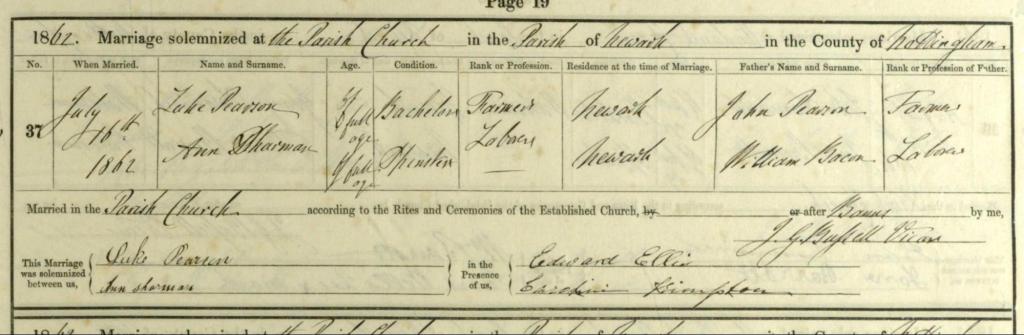
In July 1862, Luke and Ann married in Newark, both giving their residence as the town and Luke’s occupation as a farm labourer[16]. The shift suggests they had recently left Cowley Bar, possibly in search of seasonal work or a fresh start closer to Ann’s home county. Their decision to marry in Newark, away from Holmesfield, may have been motivated by convenience, privacy, or Ann’s family ties in nearby Edingley.
Marriage register entry for Luke and Ann
By the following spring, the couple had moved again—this time to Hockerton, a small village just north of Southwell—where their first daughter Mary Ann was born in April 1863[17]. Luke was now employed as a tollgate collector, a position that often came with tied accommodation and steady, if modest, income. His earlier familiarity with tollgates in Cowley Bar likely helped him secure the post.
In 1867, Luke reappears in the records as the occupier of a grocer’s shop, beerhouse and bakehouse in Edingley—Ann’s home village[18]. Their cottage was next door to Ann’s adoptive father, Thomas Foster. This move marked a return to shopkeeping, but with added stability, now rooted in a community they likely knew well. It may have been a natural next step for a couple seeking to establish themselves after years of moving between roles and locations. Whether through family connections, opportunity, or local need, Edingley became their long-term home and it was here that more children followed: Ellen Jane, Annie Elizabeth, and finally their only son William in 1874—when Luke was 56.[19]
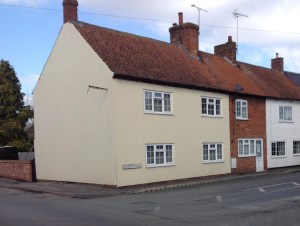
Location of Luke and Ann’s beerhouse at corner of what is now Main St and Station Rd, Edingley
Running a beerhouse brought its own challenges. In 1869, new licensing laws required licensees to meet strict standards — no disorder, drunkenness, or gambling — or risk losing their license at the annual ‘brewster sessions’[20]. Luke would have had to tread carefully. Notorious locals like cottager John Davidson, the so-called “Edingley Giant,” had often been charged with public drunkenness and indecency. Davidson died in 1869, perhaps to Luke’s quiet relief[21].
Tragedy struck in 1877 when Ann died of pneumonia aged just 44 years old.[22] Left with three young children, Luke likely relied heavily on Mary Ann, then 14, to help run the household and business. By 1881, she had married and moved next door with her own baby, and Luke continued to run the shop with Ellen Jane and William.[23]
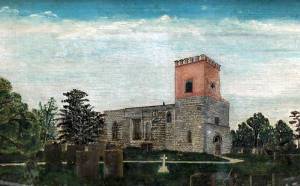
Depiction of Edingley church as it would have looked at the time of Ann’s funeral in 1877
Luke’s later life in Edingley was not without its dramas. In April 1881, he gave evidence in a burglary case after a man broke into the home of local shoemaker John Hallam. From his premises nearby, Luke had seen the suspect near the toll road and later observed him vanishing behind Hallam’s house, confirming key details in the prosecution’s case[24]. Just a few years later, in 1884, he himself was the victim of petty theft when a local youth stole a mustard pot containing money from his shop[25]. Then in 1893, a drunk labourer stole Luke’s jacket from the pub while under the influence[26]. These minor episodes, scattered across more than a decade, show Luke not only as a long-serving grocer and beerhouse keeper, but as someone whose premises stood at the heart of village life — a place where the ordinary and the unruly alike passed through.
Luke never remarried. He remained a widower and continued as a grocer and publican into his seventies.[27] He died in 1895 of acute gastritis at age 77[28]. His estate was valued at £62[29]—modest but a testament to a lifetime of steady effort—and his son William succeeded him in running the business, continuing the Pearson presence in Edingley for at least another generation.[30]
Luke and Ann’s lives, rooted in farming and framework knitting, were transformed by perseverance into one of enterprise and community. He abandoned a familiar life for something new; she endured and overcame hardship; together they built a legacy of self-reliance and community that continued through their children.
[1] Baptism record of Luke Pearson, Holmesfield, 1818
[2] Baptism/burial records for Caroline and Selby Pearson, Holmesfield, 1822
[3] Pigot and Co’s Commercial Directory for Derbyshire, 1835
[4] 1841 Census entry for household of John Pearson, Cowley, Dronfield, HO107/1951/1
[5] Burial record for John Pearson, Holmesfield, 1845
[6] 1851 Census entry for household of Mary Pearson, Cowley Gore, Dronfield, HO107/2148
[7] Pearson/Cope family tree in possession of Valerie Pearson

 We Are The Balls