The first story I want to share is that of William Pearson (1875-1944), my great great grandfather on my mother’s side. He certainly had some hard times but was clearly a man of great fortitude and honour. He went from being branded a “failure” to being commended on the front page of the local newspapers. William’s story begins in 1896, a few months after his elderly father Luke had died.
William, who had just turned 21, took over his father’s beerhouse and grocer’s shop in the small village of Edingley in north Nottinghamshire[1]. A few years later he married local girl Annie Cope and they had 5 children together, including my great-grandfather Alf. By 1911, all the family were still living together in Edingley at what was called the ‘Railway Tavern’[2].
Not long after though William fell on difficult times. Clearly not making enough money from his father’s business to support his family, he had also been working as a market gardener and as the local postman to make ends meet. In 1912 however things started to unravel. He was sued by a brewery company for non-payment of a loan and 12 months later was in front of the ‘Official Receiver’ in Nottingham having filed his own petition for bankruptcy. One newspaper reported the case under the headline “local failure”[3].
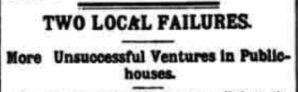
But it wasn’t just a downturn in trade which did for William. In his bankruptcy hearing he told of “illness of himself and his wife and family”. It transpired that for several months William had been in a sanitorium for consumptives and Annie and the children had also been sick for a long time, requiring medical attention[4]. Consumption, now known as pulmonary tuberculosis, was still a major public health issue in the early 20th century and the BCG vaccine was yet to be developed. Working in a crowded indoor environment such as the tavern would have increased the risk of exposure for William and Annie[5] and having contracted the infection they, and their young family, would likely have suffered from persistent coughs, extreme fatigue and night sweats[6]. Little wonder then that he was unable to keep the wolf from the door.
After such a debilitating illness and public humiliation, you could forgive William if he had quietly retreated to Edingley to spend his days eking out a meagre living from his small garden. But not William. When war broke out shortly after, despite now being over 40, he joined the army and served for nearly five years, performing “excellent secret service” in India.
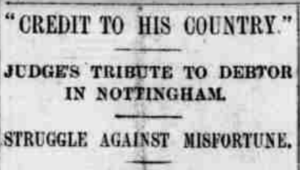
On his return, although still in poor health, he was keen to get back on his feet and applied to the County Court to be discharged from his bankruptcy. He wanted to use a Government grant to buy some land and set up a market gardening business, and offered to pay back some of his debt in monthly instalments[7]. Once again William found his story reported in the local newspapers, but this time they related his “struggle against misfortune” and quoted a glowing tribute from the judge:
“[Mr Pearson] was the subject of misfortune, taking the shape of illness and, with regard to his subsequent career, he is a man of whom it may fairly be said that he is a credit to his country, deserving every consideration that can be extended to him and every expression of commendation and every honour that can be paid to him by a grateful country.”
Nottingham Evening Post, 16th October 1919
The judge granted William’s request, but it seems that once again his business didn’t work out, and he ended up working out his days as a banksman at Clipstone colliery, supervising the miners as they entered and exited the pit[8]. Although it may not have been his first choice, it was a crucial job to ensure the safety of the workers and William was entrusted with a high level of responsibility. His bad luck continued when he and his son Lester found themselves ‘locked out’ of the pits for 3 months during the 1921 mining crisis for refusing to accept wage reductions[9]. Once again, in the face of adversity, William Pearson acted with bravery and integrity.
In the end, William retired from the colliery due to incapacity[10], perhaps suffering from the long term effects of his bout of TB. He died in 1944 at the age of 68[11], but will be remembered as a man of honour and a credit to his family and his country.
References
[1] Newark Advertiser, 29 April 1896
[2] 1911 census of England & Wales
[3] Nottingham Daily Express, 16 July 1913
[4] Nottingham Evening Post, 16 October 1919
[5] Working conditions and tuberculosis mortality in England and Wales, 1890–1912, https://www.ncbi.nlm.nih.gov/pmc/articles/PMC4875674/
[6] Tuberculosis (TB) – Symptoms, https://www.nhs.uk/conditions/tuberculosis-tb/symptoms/
[7] Nottingham Evening Post, 16 October 1919
[8] 1921 census of England & Wales
[9] ‘Census 1921 – Baby it’s Cold Outside’, https://mlfhs.uk/blog/baby-it-s-cold-outside
[10] 1939 Register
[11] England & Wales Death Index
 We Are The Balls