My next piece is a long one and a little closer to home (metaphorically, if not literally). It is about my granny Dina’s grandmother, Jeanie McLean and is the story of how (and perhaps why) she took all of her family from Scotland to New Zealand, except for her eldest daughter Mary (Dina’s mum). We are very lucky to have an audio recording of Mary talking with Dina and her son Martin about her life – something which inspired me to record my granny in a similar way. I have drawn on both of these recordings, amongst many other family and documentary sources, for this biography of Jeanie and there is a short extract from the recording of Mary included within the story. I have tried to remain relatively objective when describing what happened, but with only a first-hand account of one side of the story there may well be an element of bias. Although I got some information from Jeanie’s grandson Lyall years ago, I now regret not speaking more to him before his death in 2013. Perhaps one day I’ll unearth more details from my remaining distant cousins in New Zealand.
(From now on I will include a short intro like this in these blog posts and link to the full story on a separate page. Hopefully that will make the site a little less cluttered going forwards)
In the mid-19th century, during the “golden age of English agriculture”, Luke Pearson turned his back on farming and moved to another county to forge a new path. Leaving behind the life he had grown up with, Luke took a risk and – with his wife, Ann Sharman – created a business which his son would one day take over.
Luke was born in 1818, the tenth child of John and Mary Pearson[1]. By the time he was three, his mother had borne twins both of whom sadly died in infancy[2]. The family lived in the Cordwell Valley, two miles from Holmesfield, in an area known simply as ‘Bank’, rising steeply via Fox Lane. Holmesfield itself was a small village described in one source as being “highly respectable” with “several very genteel habitations”[3]. Nestled on the eastern edge of the Peak District, the area is surrounded by rolling farmland, wooded valleys, and distant moors.
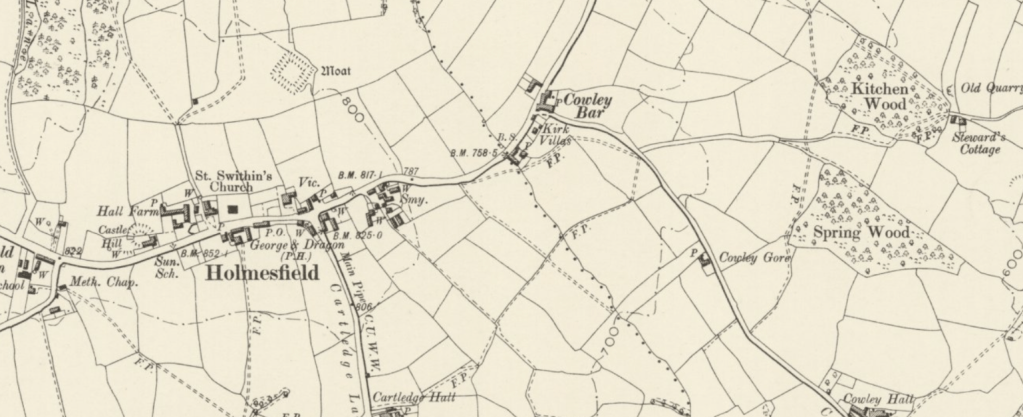
By 1841, the Pearsons were farming in nearby Cowley Gore, with Luke as the only child remaining at home[4]. He worked as a farm servant alongside his father until John’s death in 1845[5]. Luke stayed on to help his widowed mother on the smallholding[6] but after her death in 1854 he began to chart a new course[7]. He became the tenant of Southwood Farm on Hill Top in Dronfield[8], a well-equipped mixed farm with horses, cattle, pigs and even hives of bees. This was not subsistence farming but a relatively comfortable domestic life with a degree of self-sufficiency and modest prosperity.
Yet by his late 30s, Luke remained unmarried and was perhaps restless. His father had fathered eight children by that age; Luke was still turning the soil alone. One can imagine him at the close of a long summer day in 1856, leaning on his plough, watching the sun dip behind Long Acre Wood, wondering if the life he knew was all there was.
View from Hill Top towards Long Acre Wood, photo by Ed Ball
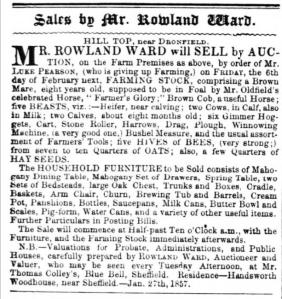
Then in 1857 Luke made a dramatic change[9]: he gave up farming, auctioned off his livestock, equipment and furniture, and moved to Cowley Bar to establish a grocer’s shop.
Notice of auction, Sheffield Independent, 31 Jan 1857
Cowley Bar was a hamlet on a branch of the Sheffield–Derby turnpike, near a tollgate through which coaches and carts frequently passed. The close proximity of the tollgate may have introduced Luke to toll collection as a line of work—an experience that would soon prove relevant. It was also at Cowley Bar that Luke employed a young servant named Ann Sharman[10]. Though not yet married, Luke and Ann’s relationship became strong, and the arrangement suggests a close domestic partnership well before formal vows.
Ann was born in 1833 in Kirklington, Nottinghamshire, the illegitimate daughter of Isabella Sharman of Sutton cum Duckmanton[11]. Her baptism record did not name a father, and she grew up in Edingley, where her mother had married Thomas Foster in 1835[12]. Though she retained the surname Sharman, Ann lived as part of the Foster household, alongside her half-siblings. By 1851, she worked as a framework knitter, a common but gruelling trade in Nottinghamshire, likely taught to her by her stepfather.[13]
In 1850, Ann’s name briefly appeared in the local newspaper after a man named Thomas Linney was charged with assaulting her in Edingley[14]. Though the case was settled with costs paid, it’s a rare glimpse into the risks faced by working-class women and Ann’s willingness to seek justice. In 1861, Luke also found himself in the news after he was involved in a coach accident near the Cowley Bar tollgate. He was riding on George Allen’s coach when it collided with a rival driven by John Godber. As a witness, Luke testified that he had warned Allen to stop as they neared the bar, but Allen drove on, leading to the fatal injury of a horse. The court ruled in Godber’s favour, the incident underlining Luke’s presence as a trusted local figure.[15]
1893 map showing Holmesfield, Cowley Bar and Cowley Gore
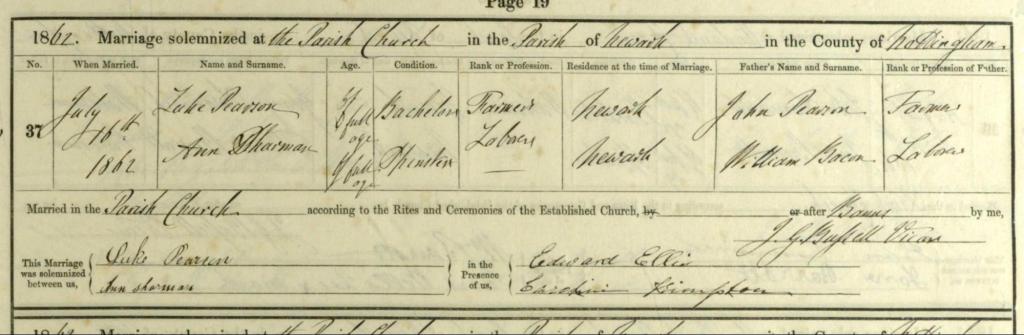
In July 1862, Luke and Ann married in Newark, both giving their residence as the town and Luke’s occupation as a farm labourer[16]. The shift suggests they had recently left Cowley Bar, possibly in search of seasonal work or a fresh start closer to Ann’s home county. Their decision to marry in Newark, away from Holmesfield, may have been motivated by convenience, privacy, or Ann’s family ties in nearby Edingley.
Marriage register entry for Luke and Ann
By the following spring, the couple had moved again—this time to Hockerton, a small village just north of Southwell—where their first daughter Mary Ann was born in April 1863[17]. Luke was now employed as a tollgate collector, a position that often came with tied accommodation and steady, if modest, income. His earlier familiarity with tollgates in Cowley Bar likely helped him secure the post.
In 1867, Luke reappears in the records as the occupier of a grocer’s shop, beerhouse and bakehouse in Edingley—Ann’s home village[18]. Their cottage was next door to Ann’s adoptive father, Thomas Foster. This move marked a return to shopkeeping, but with added stability, now rooted in a community they likely knew well. It may have been a natural next step for a couple seeking to establish themselves after years of moving between roles and locations. Whether through family connections, opportunity, or local need, Edingley became their long-term home and it was here that more children followed: Ellen Jane, Annie Elizabeth, and finally their only son William in 1874—when Luke was 56.[19]
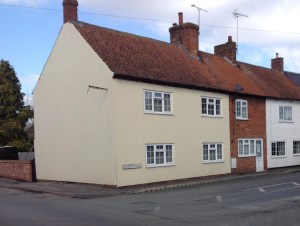
Location of Luke and Ann’s beerhouse at corner of what is now Main St and Station Rd, Edingley
Running a beerhouse brought its own challenges. In 1869, new licensing laws required licensees to meet strict standards — no disorder, drunkenness, or gambling — or risk losing their license at the annual ‘brewster sessions’[20]. Luke would have had to tread carefully. Notorious locals like cottager John Davidson, the so-called “Edingley Giant,” had often been charged with public drunkenness and indecency. Davidson died in 1869, perhaps to Luke’s quiet relief[21].
Tragedy struck in 1877 when Ann died of pneumonia aged just 44 years old.[22] Left with three young children, Luke likely relied heavily on Mary Ann, then 14, to help run the household and business. By 1881, she had married and moved next door with her own baby, and Luke continued to run the shop with Ellen Jane and William.[23]
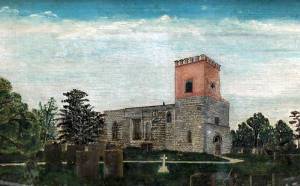
Depiction of Edingley church as it would have looked at the time of Ann’s funeral in 1877
Luke’s later life in Edingley was not without its dramas. In April 1881, he gave evidence in a burglary case after a man broke into the home of local shoemaker John Hallam. From his premises nearby, Luke had seen the suspect near the toll road and later observed him vanishing behind Hallam’s house, confirming key details in the prosecution’s case[24]. Just a few years later, in 1884, he himself was the victim of petty theft when a local youth stole a mustard pot containing money from his shop[25]. Then in 1893, a drunk labourer stole Luke’s jacket from the pub while under the influence[26]. These minor episodes, scattered across more than a decade, show Luke not only as a long-serving grocer and beerhouse keeper, but as someone whose premises stood at the heart of village life — a place where the ordinary and the unruly alike passed through.
Luke never remarried. He remained a widower and continued as a grocer and publican into his seventies.[27] He died in 1895 of acute gastritis at age 77[28]. His estate was valued at £62[29]—modest but a testament to a lifetime of steady effort—and his son William succeeded him in running the business, continuing the Pearson presence in Edingley for at least another generation.[30]
Luke and Ann’s lives, rooted in farming and framework knitting, were transformed by perseverance into one of enterprise and community. He abandoned a familiar life for something new; she endured and overcame hardship; together they built a legacy of self-reliance and community that continued through their children.
[1] Baptism record of Luke Pearson, Holmesfield, 1818
[2] Baptism/burial records for Caroline and Selby Pearson, Holmesfield, 1822
[3] Pigot and Co’s Commercial Directory for Derbyshire, 1835
[4] 1841 Census entry for household of John Pearson, Cowley, Dronfield, HO107/1951/1
[5] Burial record for John Pearson, Holmesfield, 1845
[6] 1851 Census entry for household of Mary Pearson, Cowley Gore, Dronfield, HO107/2148
[7] Pearson/Cope family tree in possession of Valerie Pearson
William Maddock (later Mattock) and Keziah Jackson spent their entire lives in the rural Lincolnshire fens, raising 11 children while struggling to make ends meet. William was born in Dowsdale near Crowland[1], but his life changed dramatically when his father died when he was just 12[2]. Left without a paternal figure, he worked for a grazier named James Whitsed in nearby Postland[3]. William’s duties likely included raising cattle or sheep for market, with food and lodging provided in exchange for his labor. He was one of three servants working for Whitsed and his wife.
Meanwhile, Keziah, nearly three years younger than William, grew up less than two miles away in Whaplode Drove at her parents’ home on Green Bank[4]. Her father, James Jackson, was an agricultural laborer, so it’s likely that William and Keziah crossed paths during their youth in the 1840s, though they didn’t marry until later.
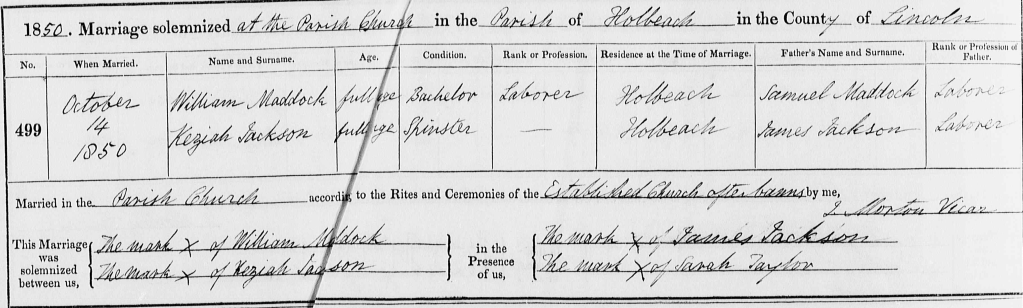
By 1850, they were engaged, and on October 14 of that year, William (23) and Keziah (20), who was already four months pregnant, traveled to the market town of Holbeach. There, they were married at the Church of All Saints by Reverend James Morton[5]. Neither the bride nor the groom could sign their names, so they, along with the witnesses James Jackson (Keziah’s father) and Sarah Taylor, marked the register with an ‘X.’
Marriage register entry, showing ‘X’ signatures
The couple initially settled in Moulton[6], just a few doors down from Keziah’s parents, where their first son, James, was born in early 1851[7]. Soon, they moved to Holbeach Fen, a place where they would remain for the next four decades. William took up work as a shepherd[8], and the family grew rapidly, adding five more sons—John, William, Samuel, and Charles—and two daughters, Mary and Elizabeth, over the next 11 years[9].
Life in the mid-nineteenth century was hard for a family of their size. Formal schooling did not become widespread until 1870, so the older children—particularly the boys—likely helped with farm work to supplement the family income. Keziah and the older girls took care of the household chores and looked after the younger children. Education was often an afterthought, with reading and writing seen as unnecessary skills for farm work.
Money was tight, and with so many mouths to feed, proper nourishment was difficult to come by. Illnesses, particularly childhood diseases like measles, were common and deadly. Measles, which was typically a mild infection, was one of the leading causes of death for children during this time, and in 1863, it claimed the life of their second eldest child, John. After a long day’s work in the fields, possibly weakened by malnutrition, John fell ill, and despite Keziah’s likely efforts to treat him with tonics and remedies, he died on May 26, 1863, aged just 10[10].
Over the next few years, the Mattocks had four more children—David, Thomas, Jacob, and Ruth. With the addition of each child, making ends meet became increasingly difficult. However, a turning point came in 1870 with the establishment of local education authorities. For the first time, the older children could attend regular school, and Keziah was able to contribute more to the family’s earnings.
With an agricultural depression beginning to affect the region, William and Keziah, now in their 40s, decided to open a beerhouse. A “beerhouse” was a private home where an “ale wife” could brew and sell beer. They later took over the Bell Inn on Cranesgate in Whaplode, supplementing their income by renting rooms to lodgers. Despite the growing business, William continued working as a farm laborer and kept cows on their four-acre plot of land[11].
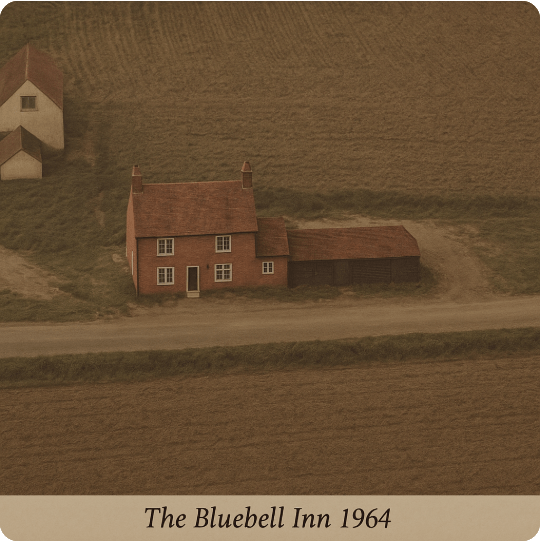
AI-generated depiction of the Bell (by then the Bluebell) Inn from an original photo provided by the current owner, John Lusher. He believes the pub hadn’t changed much by 1964 when the photo was taken.
Running an inn was far from straightforward. In 1871, the Bell Inn was the site of a dramatic and dangerous event. A man named John Wallace, an Irish harvestman, began causing a disturbance in his room in the early hours of the morning, smashing furniture and throwing it through the window. The other lodgers cowered in fear as a policeman, PC Woodhall, was summoned from Holbeach, four miles away. Wallace, in a violent rage, struck the officer on the head with part of a cast iron fender. Though wounded, PC Woodhall, with the help of some other men, was able to subdue Wallace, who was later declared insane and committed to the County Lunatic Asylum[12].
The Mattocks also faced challenges due to the Licensing Acts, particularly the 1872 Act. This law limited closing hours to 11 pm in rural areas and regulated beer content, even allowing local authorities to ban alcohol altogether. The Act led to protests and near-riots as publicans resisted what they saw as an attack on their livelihoods. William received a caution in 1877[13] after being fined for permitting drunkenness at the Bell[14]. For many in the industry, losing their license would have meant financial ruin, and the annual licensing meeting at the Sessions House in Spalding must have been an intimidating event for someone like William, who could ill afford to lose his business.
In 1884, the Third Reform Act extended the right to vote to men who owned property worth £10 or more, including William. This shift meant that for the first time, he was part of a larger group of rural men who gained the right to participate in national elections.
As the years passed, William and Keziah saw many of their children marry and start families of their own[15], both in the Holbeach area and beyond. The 3 girls all married local farm workers but of their sons only James remained nearby, running an inn in Sutton St. James[16], while the others ventured out in search of work. Jacob, David, and Thomas moved to Yorkshire for industrial work, although David later returned to Whaplode, where he became a farmer. Samuel worked in Heckington and Helpringham before settling in to work on the railways. Charles, and possibly William, emigrated to Ontario, Canada, to continue farming.
By 1891, William, 64, and Keziah, 61, were still running the Bell Inn. Their son Thomas, now 23, had joined them in the family business, while in neighboring properties, their daughter Mary lived with her three children, and their son David had settled nearby with his wife and child.
However, by 1895, the family dynamic had shifted. David had relocated to Attercliffe, Sheffield, in search of work, while Thomas had married and started his own family.
Keziah passed away on February 8, 1897, at the age of 67 after a stroke[17], what was then referred to as “Cerebral Disease, Paralysis.” William, suffering from dementia and unable to care for himself, was admitted to the Holbeach Union Workhouse. He died 10 months later, on December 28, 1897, at the age of 70[18].
[1] Transcript of William’s baptism record in Thorney, Cambs, 21 Jan 1827, “Cambridgeshire Baptisms”, FindMyPast [2] Index entry for Samuel Maddock, Holbeach, Lincs, 1839, “England & Wales, Civil Registration Death Index, 1837-1915”, Ancestry [3] 1841 Census entry for James Whitsed, Portland, Crowland parish, HO107/606/13 [4] 1841 Census entry for James Jackson, Green Bank, Whaplode Drove, HO107/612/3 [5] Parish register for Holbeach All Saints, marriage entry for William Maddock & Keziah Jackson, Oct 14 1850 [6] 1851 Census entry for William Mattock, Queen’s Bank, Moulton, HO107/2096 [7] ibid. [8] 1861 Census entry for William Mattock, St. John’s Road, Holbeach All Saints, RG9/2330 [9] 1871 Census entry for William Mattock, Dog Drove, Holbeach St. John’s, RG10/3332 [10] Death register entry for John Mattock, 26 May 1863 Holbeach Fen, son of William Mattock, farm labourer [11] 1881 Census entry for William Mattock, Bell End Cranes Gate, Whaplode St Mary’s, RG11/3211 [12] Lincolnshire Free Press, 19 Sep 1871 and Lynn News County Press, 23 Sep 1871 [13] Stamford Mercury, 7 Sep 1877 [14] Lincolnshire Free Press, 3 Apr 1877 [15] Lincolnshire Marriages and Banns, FindMyPast [16] 1881 Census entry for James Mattock, Old Fen Dike “Chequers Inn”, Sutton St. James, RG11/3207 [17] Death register entry for Kezia Mattock, 8 Feb 1897 Whaplode Fen, wife of William Mattock a farm labourer [18] Death register entry for Willam Mattock, 28 Dec 1897 Holbeach Union Workhouse, Fleet, formerly an Innkeeper of Whaplode



 We Are The Balls