Pillars of Helpringham

Sam and Sarah Mattock were married for 42 years and became pillars of the community in the village of Helpringham in Lincolnshire. From inauspicious beginnings they forged their own path and dedicated themselves to helping both the young and old of their local area, despite lives punctuated with tragedy. Sam was a competent and energetic man, one of Helpringham’s first parish councillors1 and served as Superintendent of the Sunday School for over 20 years2. The two of them were heavily involved in the Primitive Methodist Chapel with Sam as a preacher, secretary and trustee, and Sarah a dedicated organiser and caterer of local events and member of the choir. They had four children together, living for many years in Rose Cottage near to the centre of the village, with Sam spending most of his days working on the railway.

A Young Bride and an Early Start 

Sarah Ann Warrington was born in Heckington3, a large village on the road from Boston to Sleaford, nestled among lush pastures with views across the Fens. She was only 16 when she married 22-year-old farm labourer Sam Mattock in the spring of 1880, though she listed her age as 19 on the marriage register4. Already two months pregnant, she may have felt the urgency of marriage, perhaps encouraged by her widowed mother, Jane, who worked as a charwoman to make ends meet. Sarah’s father, Fred Warrington, had died when she was only 25.

Sam had moved north from his family home 20 miles away near Holbeach6. His father was a shepherd, while Sarah’s brothers were all farm labourers so they likely met through mutual acquaintances or at a local agricultural show or fair.

The wedding took place at the Register Office in Sleaford, a choice often made for reasons of privacy and affordability7—particularly for young couples in Sarah and Sam’s situation. The witnesses were their close friends, George and Sarah Houlden, siblings of a similar age8. Just six months later, on 30 November 1880, their first child, Clara Jane, was born, her middle name a tribute to her grandmother.

In the 1881 census9 Sam, Sarah, and baby Clara were recorded at Jane’s house in Heckington. Perhaps they were visiting, or maybe, like many young couples, they had no choice but to share a roof with family while saving for a home of their own. Over the next few years, their family grew with the arrival of Charles in 1883 and Annie in 188510. But joy turned to heartbreak when little Annie contracted typhoid fever. She passed away at just two years old, her small body exhausted by the disease11.  Now treatable with antibiotics, typhoid is a highly contagious bacterial infection which was very common at the time and especially prevalent in areas with poor sanitation or limited access to clean water. The family buried Annie on 5 January 1888 at St Andrew’s Church in Helpringham12, where they were now living on the Green near the Methodist Chapel. It was a loss they would carry with them for the rest of their lives.

The Green, Helpringham c1906

A Life on the Railway 

By the late 1880s, Sam had left agricultural work for the railways, seeking steadier employment. The Helpringham Station opened in 188213 and he found work as a platelayer14, inspecting and maintaining the tracks. The work must certainly have suited him better as he stayed in the same job for the next 40 years. He would however have spent long, arduous hours walking the line with a gang of men, replacing worn out rails or rotten sleepers, levelling the tracks, weeding and clearing drains15. It was hard work, poorly paid and a job with little opportunity for advancement (“the most neglected man in the service”). Sam however was clearly industrious and earned a promotion to foreman in later years16.

A railway track maintenance gang, early 1900s

Another downside of railway work was the risk to life and limb. It was not uncommon for platelayers to be accidentally struck by trains, often with fatal consequences. In one incident of the time, a careless worker on the Great Northern Railway was waving to a coal train when he got hit by a passenger express coming the other direction. He was completely decapitated, his head later being found 30 yards away from his body17. Although Sam may have avoided serious injury, he almost certainly knew some who were less lucky and was himself involved in a distressing incident of another kind later in his career.

Around 8.30 on one damp January morning, Sam was at work about half a mile from Helpringham station. He noticed something white in the ditch by the side of the line and on closer inspection discovered a small bundle. At first sight it appeared to be clothing but Sam was horrified to find that the parcel was in fact the body of a baby boy wrapped in old bed quilting. He took the body to the local police who concluded that the child had been born very recently and likely died before being thrown from a fast train the previous evening18.

The harrowing sight would have stuck in the memory for anyone, but possibly more so for Sam who had a particular fondness for children. He delighted in his role as class leader at the Methodist Sunday School and his affection for his students was certainly reciprocated19.

Helpringham Primitive Methodist Chapel, rebuilt in 1883

Building a Home and a Community 

By 1893, the Mattocks’ family was complete with the birth of their second son, Samuel Jr. Around the same time, Sarah’s elderly mother, Jane, moved in with them at Rose Cottage20, where she remained until her passing in 190321.

As their children grew, life carried them beyond Helpringham. By 1901, 18-year-old Charles had moved to Sheffield, finding work in the steel industry and lodging with his cousin, William, the eldest son of Sam’s brother James22. Clara remained at home, working as a dressmaker, but her trips to visit Charles would soon lead her to meet her future husband, Charles Edward Ball (known as Charlie). One of Samuel Jr’s first jobs was with the GN & GE Railway in Lincolnshire23, a position he perhaps secured through his father’s contacts at the company. He later worked as a goods clerk at Misterton Station near Doncaster24.

Over the years, all three surviving Mattock children married—first Charles to Cecilia in 190625, then Clara to Charlie in 191026, and finally Samuel to Ethel in 1919. One can imagine Sam exchanging stories with Charlie’s father, Charles Ball Sr, who also worked on the railway27. It must have been a proud moment for Sam and Sarah to witness each of their children build their own lives and families.

Sam and Sarah Mattock (front) with Clara, Samuel Jr, Charlie and Cecilia behind (c1906, possibly taken to mark Charlie and Cecilia’s wedding)

A Sudden Loss 

With their children grown, Sam and Sarah remained together at Rose Cottage, their days filled with work, church, and simple pleasures. They had lived there from at least 1910 when they rented the property from elderly estate owner and local dignitary Robert Ellis Watling28. Sam maintained a large allotment near the railway and Sarah took pride in cooking and preserving food29.

Then, on a chilly afternoon on 9 November 1922, tragedy struck. Sam, at 64, was at work as usual but mentioned feeling unwell. Determined to carry on, he continued his duties until mid-afternoon. As he walked toward the station-yard, he suddenly collapsed. By the time his colleagues reached him, he was gone—his heart had failed. His death was so sudden that an inquest was held the next day. The news sent shockwaves through Helpringham, with local papers reporting that “quite a gloom was cast over the village.”. The funeral service was held at the Primitive Methodist Chapel the following Monday and was largely attended by many friends and family. Old scholars of the Sunday School lined the cemetery path as their “dear Superintendent” was laid to rest30.

Life as a widow

Sarah lived on for 27 years after Sam’s passing. She remained at Rose Cottage, now joined by Clara and her husband Charlie Ball, along with their sons, Ted and Ron who called her ‘Gran’. With Charlie’s health declining, the couple purchased the cottage from Sarah’s landlord, ensuring the family home stayed in their hands. Mother and daughter kept busy growing vegetables, preserving fruit, and cooking together, while the boys attended Donington Grammar School31.
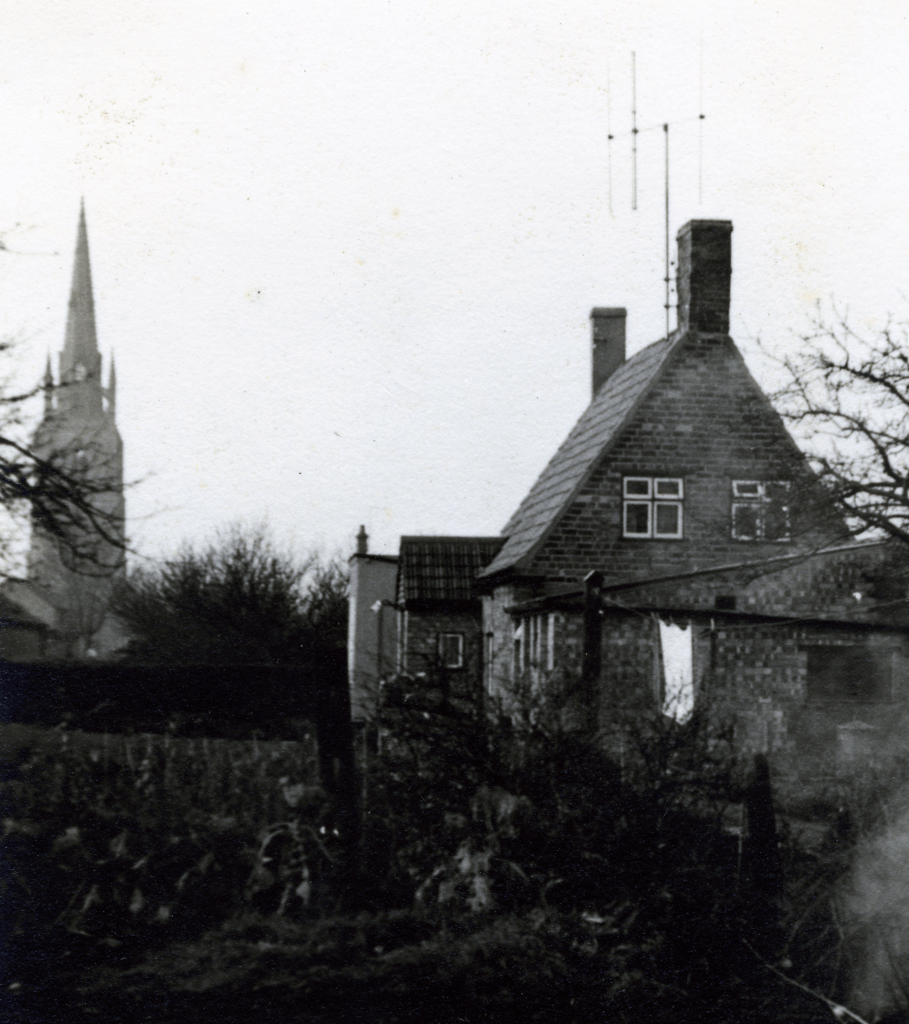
Rose Cottage, 1951

However, tragedy struck again in 1944. Amidst the turmoil of World War II, Charlie Mattock’s wife, Cecilia, took her own life in Helpringham Beck32. Her coat, shoes, hat, and spectacles were neatly arranged on the bank. She had long suffered from depression and had spent time in a mental hospital. Her loss was another painful chapter in the family’s history.

Sarah, now in her eighties, lived to see the end of the war. She passed away on 1 September 1949, aged 86, from heart disease33. She was laid to rest beside Sam in a double plot at the High Street cemetery in Helpringham—a final reunion after decades apart.

A Lasting Legacy 

Sam and Sarah’s story is one of resilience, love, and service. From a hurried young marriage to a lifetime of community devotion, they faced their share of struggles but left behind a family deeply rooted in the values they held dear. Their legacy continues in the generations that followed, woven into the history of Helpringham and beyond.

Four generations: Sarah (left), with daughter Clara, grandson Ted, his wife Joan and baby Graham. July 1947

1  Grantham Journal, 2 Dec 1894
2  Sleaford Gazette, 18 Nov 1922
3  1871 census, Heckington, household of Jane Warrington
4  Marriage certificate of Samuel Mattock and Sarah Ann Warrington
5  Stamford Mercury, 23 Mar 1866
6  1871 census, Holbeach, household of William Mattock
7 Avoiding Attention? Assessing the Reasons for Register Office Weddings in Victorian England and Wales. https://www.tandfonline.com/doi/full/10.1080/14631180.2023.2205736#d1e109
8  Marriage certificate, ibid.
9  1881 census, Heckington, household of Jane Warrington
10  1891 census, Helpringham, household of Samuel Mattock
11  Death register entry for Annie Mattock
12  Lincolnshire parish registers, 1538-1911
13  Wikipedia, Helpringham railway station – https://en.wikipedia.org/wiki/Helpringham_railway_station
14  1891 census, ibid.
15 The Dirt of the Victorian Railway Industry – The Platelayers, https://turniprail.blogspot.com/2010/11/dirt-of-victorian-railway-industry.html?m=1
16  Grantham Journal, 1 Feb 1913
17  Nottinghamshire Guardian, 16 Dec 1893
18  Grantham Journal and Sleaford Gazette, 1 Feb 1913
19  Sleaford Gazette, 18 Nov 1922
20  1901 census, Helpringham, household of Samuel Mattock
21  Death index entry for Jane Warrington
22  1901 census, Attercliffe cum Darnall, household of Sarah Ann Walker
23  1911 census, Cowbit nr Spalding, household of Middleton Pinder
24  1921 census, Misterton, household of Samuel Mattock
25  Marriage index entry for Charles Mattock
26  Marriage certificate of Charles Edward Ball and Clara Jane Mattock
27  1901 census, Attercliffe cum Darnall, household of Charles Ball
28  Email from Julie Close (Helpringham History Society) to Jaine Burton
29  Letter from Allen Mattock, 10 May 2010
30  Louth Standard 25 Nov 1922 and Sleaford Gazette 18 Nov 1922
31  Interview with Dina Maclean, 6 Mar 2010
32 Sleaford Gazette, 2 Jun 1944
33 Death certificate of Sarah Ann Mattock

Research Notes

We can’t know for sure why they chose to marry at the Register Office but there are three possible reasons: to keep the wedding private; practical considerations of location, cost and speed; or ideological preferences. All of these may be factors.

The first three children were baptised at Heckington parish church but there is no record of Samuel being baptised in the parish registers. It could be that their Methodism had fully taken over by then. It’s interesting that Clara’s marriage took place at the Anglican church of St Andrew’s, but perhaps this was her husband’s influence.

I’m not sure exactly when they moved into Rose Cottage but tax records held by Julie at the Helpringham History Society showed it was at least 1910. The photo in front of the coal shed looks to have been taken around 1905, given Samuel Jr’s age. Granny said she had to fetch coal from that shed when she stayed there, suggesting that it was taken at Rose Cottage, but it could easily be a similar shed at a previous property.

It would be worth investigating if any records exist for the parish council, Sunday School, Methodist Chapel, temperance league or GN & GE Railway. More research would be valuable on the lives of Charlie and Samuel Mattock Jr.
Stitched up

John broke down in tears as Lord Denman passed his sentence. He knew he wouldn’t see his wife and new-born son again for 12 long, hard months. Although he deeply regretted the fateful mistake for which he was now dearly paying, John couldn’t help but think that he was the victim of a terrible injustice.

It was mid-June in the year 1843, and four men were talking and drinking ale in a private room at the back of the Heart’s Ease pub in the centre of Cambridge. Inspector Charles Thresher of the newly-formed Borough Police and his ex-colleague Robert Fynn were in deep conversation with two shadier characters called Frederick Shadbolt (aka “The Blackbird”) and Richard Cotton (known as “Lutterworth Dick”). Shadbolt had long been taking up to half a sovereign from the police for providing information about local criminals such as “Young Barn-door Jack”, “Doddy Shedd” and “Tambourine Sam”. But this time a plan was afoot to pocket a much greater reward. Despite innovations in coin production, counterfeiting was still a big problem throughout the country. Up until a decade ago it was considered high treason and punishable by hanging, and although it was no longer a capital offence, those found making fakes could still be transported for up to 14 years. To help catch the counterfeiters, the Royal Mint were offering a £50 reward for anyone apprehending an offender. It was thus that the four plotters hatched a plan that day for dividing such a sum between themselves, and all they needed to enact their nefarious scheme was an unsuspecting pawn to do their bidding. Dick said he knew just the man.[1][2]

John William Balls was born in 1821[3] and grew up in the shadow of St. John’s College in the north of Cambridge. Among the dirty, crooked streets were nestled beautiful academic buildings seemingly positioned at random, and low houses, with their upper stories sometimes projecting over the narrow pathways[4]. Unlike the well-heeled scholars strolling down nearby Bridge Street in their top hats, silk cravats and frock coats, John was a poor labourer’s son whose father had died when he was just 14[5].

John likely started work from an early age to support his mother and younger sisters. The growing University which dominated the town provided many opportunities for workers supplying its needs. It was also around then that law enforcement was starting to change. Previously policed by unpaid volunteers, Cambridge was one of 178 boroughs which was required to establish a professional force by a reform act of 1835[6]. The Cambridge Borough Police was thus formed and initially employed only 30 police officers. The force was still small by the 1840s, comprising 2 inspectors, 4 sergeants, and 22 constables, all overseen by Captain Bailey, the Chief Constable[7].

By 1841, at the age of 20, John was working as a French polisher[8]. This was a very labour-intensive job, involving the lengthy and repetitive application of many thin coats of shellac to wooden furniture with a rubbing pad in order to build up a high gloss finish. The resulting fine furniture would no doubt have adorned the well-appointed residences of local students.

In the same year, John married Eliza Wheeler, a shoemaker’s daughter, at the local church of St Sepulchre[9]. They lived together in a two storey house, with John’s widowed mother, on a lane opposite the medieval round church. Just over a year later, their first child, a son also called John William, was born[10].

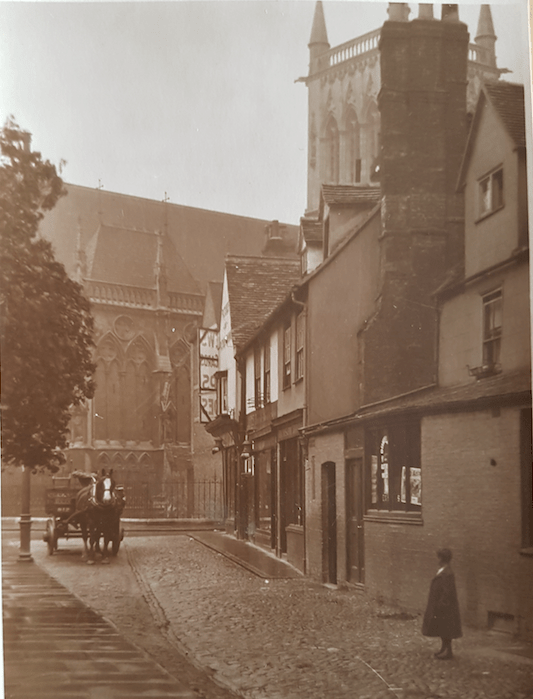
Round Church Lane, looking towards St. John’s College chapel

It was perhaps through his father-in-law’s connections that John then got a job as a shoeblack at St John’s College, cleaning and polishing the shoes of the students and academics. John would have been paid directly by the college, reporting individual bills so that students could be charged on a quarterly basis for his services. His friends and fellow shoeblacks regarded John as a good man, honest and industrious[11]. But to some of his customers he was but a lowly servant, pitied for his apparent ignorance. One particularly moralizing correspondent to a local newspaper wrote of a proposed training college for servants:

“The shoeblack will be lectured in geology and chemistry, for it is plain unless he can at once detect the strata in which his master has been walking or riding, he will not be apt to take the best method for removing the soil; and if he have ascertained that the splashes upon the boot-tops are alluvial sand, and not galt, he might still be at a loss how to expunge them unless versed in the properties of vitriolic acid.”

Cambridge Chronicle and Journal 31 December 1842

Returning to the events of 1843, it may then be clear how John, a young impressionable lad with no father figure and used to being treated as a lackey, agreed to help make some counterfeit shillings when asked by his friend Lutterworth Dick.

It was now Saturday July 1st, and the four plotters were once again at the Heart’s Ease pub. Inspector Thresher gave Lutterworth Dick two shillings and sixpence to procure the equipment needed for the job – some spoons and plaster of Paris to make the mould. Dick then went over to John’s house to set up. He returned that evening with Shadbolt to try out the process, Dick holding the mould and John pouring the metal in. He then told John he would come back later to commence work, knowing that it would in fact be the police who would next enter John’s property. The trap was set.

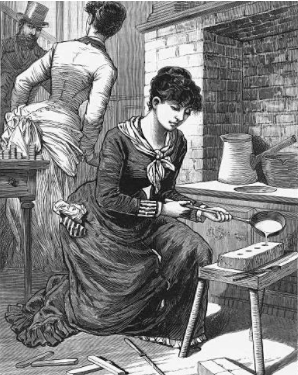
Counterfeiter pouring metal into a mould

Dick gave the signal to Thresher who stormed in with PC William Robinson at 2am on the morning of Sunday July 2nd. John, wearing his dark shoeblack’s apron, working away by the light of the fire in the quiet of the night, jumped out of his skin when they entered. He dropped the mould and a shilling fell to the floor. The police searched the room and found more shillings under an ornament on the mantelpiece and a tobacco pipe in the fire. Eliza, and John’s mother Mary, came downstairs in a state of undress to see what the commotion was, as John was hauled off and taken to the station-house[12].

At the trial a few weeks later, John’s lawyer admitted that the evidence was irrefutable, but he contended to the jury that Dick and Shadbolt were the real offenders and John was merely “a blind instrument”. Despite this, and several of John’s friends and PC Robinson attesting to his good character, the judge and jury were forced to convict – although even they did so with noted regret. The press reported that John was “a good deal affected and shed tears during the greater part of the trial”[13]. John was to serve 12 months in prison with hard labour, which at the time could have meant anything from walking on a treadmill for hours a day, carrying cannonballs up and down, or turning a crank handle thousands of times for no reason[14].

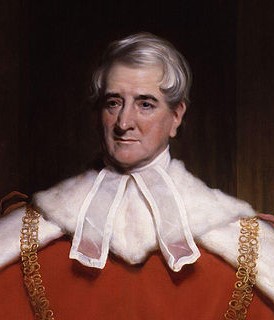
Lord Denman, who regretted having to send John to prison

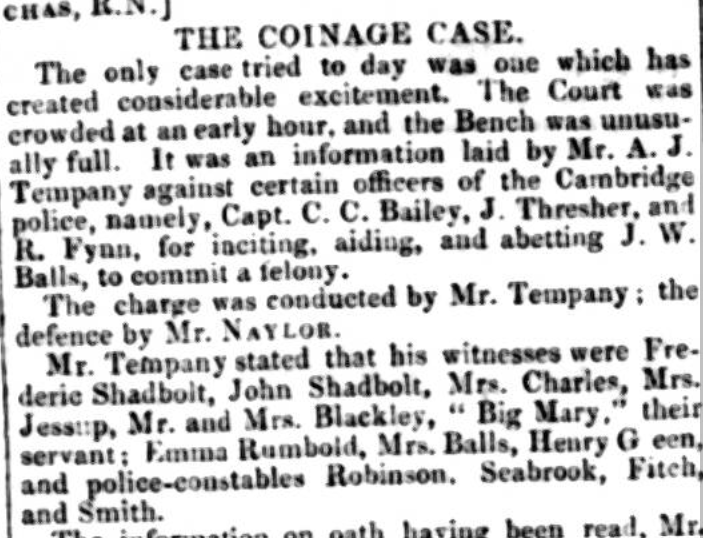
Despite John being imprisoned, Eliza refused to accept that her husband was guilty. She employed the services of an attorney to bring a charge of conspiracy against the corrupt policemen, accusing them of entrapping John in order to gain financial reward. Unfortunately the case relied on the testimony of Shadbolt and the day before it was due in court, he was detained at Bury St Edmunds for allegedly stealing money from a pub. It wasn’t until he was released the following May that a packed and excited courtroom finally heard the case, but with no other witnesses and Shadbolt of such dubious character the magistrates unanimously dismissed it, despite vociferous support from anti-police protesters[15]. It may have been some small consolation that Inspector Thresher was suspended from the force for drunkenness only a few months later.[16]

Report of the case against the police, Cambridge General Advertiser, 1 May 1844

When he got out of jail, John got back to work and family life with Eliza. They had another son, Charles, in 1846 but after 18 years of marriage, Eliza sadly died from TB[17]. John would then marry again[18] and have another 6 children with a woman 20 years his junior. He remained in the St Clement area of Cambridge and built a career as a house painter[19]. He died aged 80 in 1901[20].

References


[1] The Yellow Trade, https://victorian-supersleuth.com/the-yellow-trade/
[2] Cambridge General Advertiser, 1 May 1844
[3] Cambridgeshire Baptisms, FindMyPast
[4] “Student life at Cambridge”, Littel’s Living Age, Vol. 34, 1852, p.114-115, https://books.google.co.uk/books?id=XSszAQAAMAAJ
[5] National Burial Index For England & Wales, FindMyPast
[6] “The 1835 Municipal Corporations Act”, http://www.historyhome.co.uk/peel/politics/municip.htm
[7] Cambridge Chronicle and Journal, 7 October 1843
[8] 1841 Census of England
[9] Marriage certificate of John William Balls and Eliza Wheeler
[10] England & Wales Christening Records, 1530-1906, Ancestry.com
[11] Cambridge Chronicle and Journal, 29 July 1843
[12] Cambridge General Advertiser, 1 May 1844
[13] Cambridge Chronicle and Journal, 29 July 1843
[14] Victorian Crime and Punishment, https://www.oxfordcastleandprison.co.uk/about/news/victorian-crime-and-punishment/
[15] Cambridge General Advertiser, 1 May 1844
[16] Cambridge Independent Press, 14 September 1844
[17] Death certificate of Eliza Balls
[18] Marriage certificate of John William Balls and Mary Ann Lee
[19] Censuses of England, 1871-1891
[20] England & Wales, FreeBMD Death Index: 1837-1915, Ancestry.com

Driven to distraction

My grandma never knew her husband Les’ maternal grandfather and all she could tell me about him was that he owned several lorries in Farnsfield, Nottinghamshire and that he was an alcoholic. “I don’t even know what it was that he drunk”, she said. “It’s usually spirits, isn’t it? But I’ve no idea.”

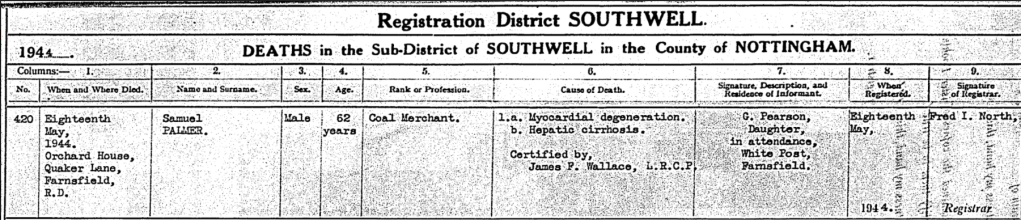
“The alcoholic”, as my mum referred to him, was called Sam Palmer (although that wasn’t his birth name) and he died from liver cirrhosis[1], a tell-tale sign of alcohol abuse, in May 1944, a few weeks before the Allied troops landed on the beaches of Normandy. Alcoholism is usually caused by a combination of societal and family factors, and can be triggered by stressful events[2]. The life of Samuel Palmer (1882-1944) provides an unfortunate case study of how circumstances, often outside of our control, can play a crucial, and sometimes damaging, part in our mental health.

Registration of Samuel Palmer’s death

To appreciate the full story we need to go back to the year before Sam was born. In 1881, 50-year-old framework knitter Samuel Hallam was living with his 23-year-old housekeeper Elizabeth on a row of knitter’s cottages in the large, straggling village of Woodborough, 8 miles north-east of Nottingham[3]. His wife Jane had died 8 years previously[4], and the young Elizabeth, daughter of Hallam’s friend Thomas Palmer was an attractive prospect for the aging widower. They started a relationship and had a daughter Rebecca, out of wedlock, followed by a son Samuel who died after only a few weeks[5]. Their third illegitimate child, another son and our subject, born in February of 1882, was also baptised Samuel Hallam[6] although he would later opt for his mother’s surname.

Over the first 10 years of young Sam’s life, he and his elder sister Rebecca suffered considerable trauma. They saw two more sisters die as babies[7] and although a brother, Harry, would survive, by 1891 their father was ill and unable to work to support the family. Things got so bad that the three children, along with their ailing father, ended up in Basford workhouse, while their mother went to stay with her sister’s family[8].

Although the children received some schooling while they were in the workhouse, and were taken on occasional outings (including a trip to Skegness[9]), they were separated from their parents (and probably each other) and must have been scared and lonely as they first tried to sleep at night in the cramped dormitories. Flogging of young boys for minor infractions was common practice in some workhouses of the time, as were reports of systematic child abuse by depraved nurses[10]. To make matters worse their father died during their time inside[11], leaving the Palmer children (as they were now known) with only each other for comfort. A Poor Law Commissioner inspecting Basford in 1891 did consider the conditions there satisfactory and reported “favourably of the food and treatment, but made suggestions with regard to bathing and amusements”[12], so perhaps Sam was relatively well looked after, albeit a little bored and grubby. Some workhouses gave the boys half a pint of beer with their dinner and supper each day[13], so maybe this was where Sam first got a taste for it.

When Sam got out of the workhouse (possibly aged 14 when he was deemed old enough to enter employment) he worked first as a wagoner[14], driving horses on a farm, and later moved into the city to work in one of the many coal mines[15]. It was here that he met Nelly Davis, a lace mender from Bulwell, and they married in 1905[16] when Nelly was several months pregnant with their first child (a daughter, Gladys). Life seemed to be improving for Sam as they lived first with Nelly’s family and then moved into a small house of their own on the same street.

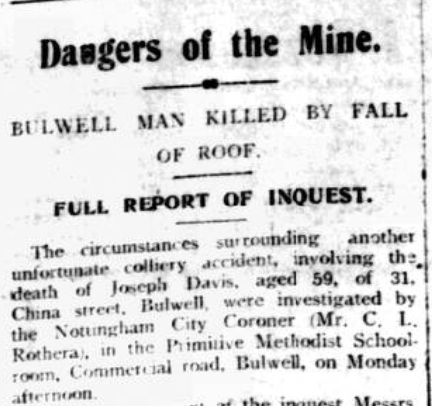
In 1913 however, tragedy struck. Nelly’s father Joseph, also a coal miner, whom Sam knew well and perhaps worked with, was killed in an accident late at night in the pit. Despite being an experienced collier, and all necessary precautions being taken, a part of the roof had fallen on him while he reached underneath[17]. Nelly and her mother must have been devastated, and Sam too who would have to keep going down into the depths to work with the thoughts of what happened to Joseph surely playing on his mind.

Report of the inquest into Joseph Davis’ death, Beeston Gazette and Echo, 1 Nov 1913.
Newspaper image © The British Library Board. All rights reserved. With thanks to The British Newspaper Archive (www.britishnewspaperarchive.co.uk)

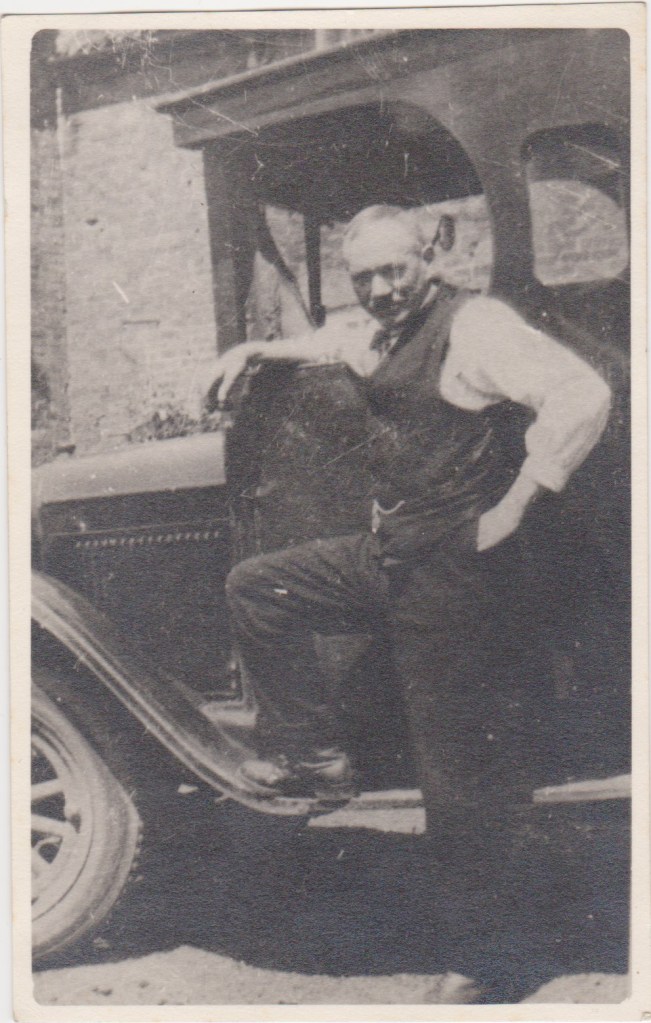
Perhaps not surprising then that Sam and Nelly, who now had a second daughter, left the city shortly after. Sam got a job at Rufford Colliery, and the family looked to be moving on from their loss as they moved into a nice cottage with a large garden in Farnsfield called Orchard House and were further blessed with a son[18].

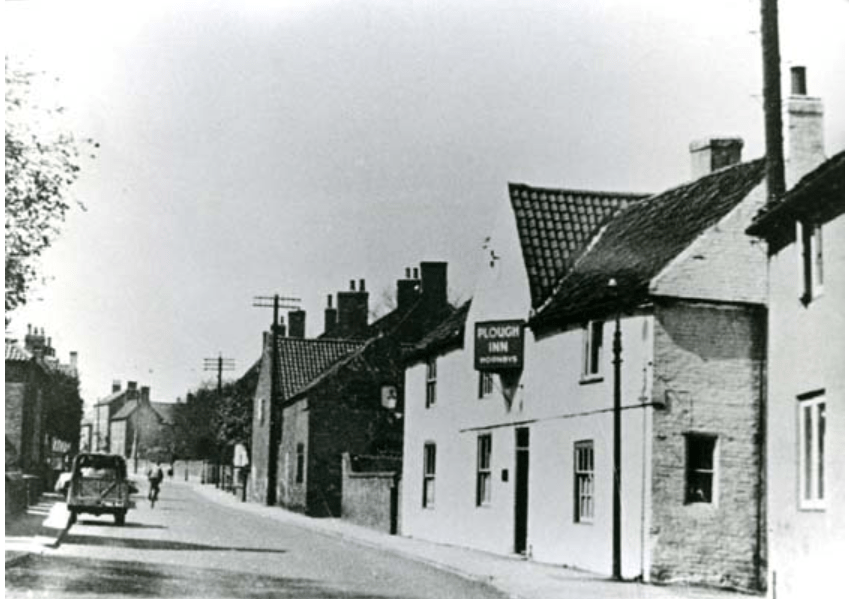
The Plough Inn, Farnsfield where Sam spent many a merry evening

Around this time, Sam was making friends in the local community, playing cricket[19] and becoming the president of the ‘Farnsfield and Edingley Pig Club’. At the club’s annual dinner at the Plough Inn in March 1924, Sam was in charge of proceedings and contributed to the general merriment with songs and poetry recitals[20]. Later that same week, daughter Nelly and son Samuel Gilbert (known as ‘Sonny’) were receiving prizes at the church schoolroom. The packed audience, no doubt including a very proud Sam and Nelly, watched the children perform sketches from Peter Pan, Alice in Wonderland and a Midsummer Night’s Dream[21]. With financial help from his brother Harry, Sam was also able to give up mining and start his own business as a haulier[22], taking advantage of the growing need for heavy goods transportation in the post-war housing boom[23].

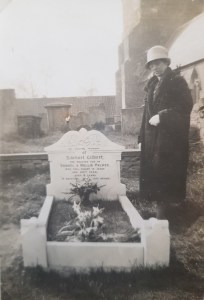
The grave of Samuel Gilbert ‘Sonny’ Palmer

As with the rest of Sam’s life though, misfortune was never far away. In January 1926, their only son Sonny, who had suffered for a long time with a spinal complaint, took ill and died a few days later[24]. He was just 9 years old. If Sam had managed to keep a lid on his drinking until then, was this the moment that everything became too much? It must have been unbearable, sitting in the cold church, seeing the sprays of flowers sent by Sonny’s schoolmates, trying to stay strong for Nelly and the girls.

Sam was a keen gardener, and in the months and years that followed Sonny’s death, he won many prizes for his fruit and vegetables at local horticultural shows (at one he was commended for his “exceptional” onions)[25]. His young daughter Nelly also had success growing wildflowers – working outside together at Orchard House and tending to their garden perhaps gave them all some solace in trying times. He continued to work as a haulage contractor[26] and play cricket for Hargreave Park on summer weekends.

Evidently Sam continued to struggle with his drinking however, and there must surely have been occasions when he was driving on the roads around Farnsfield with a mind clouded by ale, or something stronger. Although there was no legal drink driving limit until 1967, Sam could still have lost his license for 12 months, or even been sent to prison, for being caught drunk in charge of a vehicle[27]. The consequences for his business would have been disastrous.

So although Sam may have seemed like the life of the party when he was singing songs into the night at cricket club suppers at the Plough[28], underneath he never quite escaped his troubled upbringing and a life punctuated by tragedy. He died aged 62 on May 18th 1944 when his heart finally gave in[29].

Sam Palmer with one of his lorries

References


[1] Death certificate of Samuel Palmer
[2] Alcohol dependence and withdrawal, drinkaware, https://www.drinkaware.co.uk/facts/health-effects-of-alcohol/mental-health/alcohol-dependence
[3] 1881 Census of England & Wales
[4] England & Wales, Civil Registration Death Index, 1837-1915
[5] Nottinghamshire Baptisms, Nottinghamshire Family History Society
[6] ibid.
[7] ibid.
[8] 1891 Census of England & Wales
[9] Nottingham Evening Post, 14 July 1891
[10] Higginbotham, Peter “Children in the Workhouse”, https://www.workhouses.org.uk/education/
[11] England & Wales, FreeBMD Death Index: 1837-1915
[12] Hucknall Morning Star & Advertiser, 4 December 1891
[13] Higginbotham, Peter “Workhouse Food”, https://www.workhouses.org.uk/life/food/
[14] 1901 Census of England & Wales
[15] 1911 Census of England & Wales
[16] Marriage certificate of Samuel Palmer & Nelly Davis
[17] Beeston Gazette & Echo, 1 November 1913
[18] 1921 Census of England & Wales
[19] Newark Herald, various reports from 1922 to 1929
[20] Newark Herald, 8 March 1924
[21] ibid.
[22] Correspondence with Sue Palmer, 2011
[23] The history of haulage and road transport in the UK, https://www.snapacc.com/blog/0021-The-history-of-haulage-and-road-transport-in-the-UK/
[24] Newark Herald, 30 Jan 1926
[25] Newark Herald, various reports from 1925 to 1929
[26] Marriage certificate of Gladys Palmer and Alfred Pearson
[27] A History of Drink Driving & Motoring Laws in the UK, https://www.drinkdriving.org/drink_driving_information_uklawhistory.php
[28] Newark Herald, 2 November 1929
[29] Death certificate of Samuel Palmer