In the mid-19th century, during the “golden age of English agriculture”, Luke Pearson turned his back on farming and moved to another county to forge a new path. Leaving behind the life he had grown up with, Luke took a risk and – with his wife, Ann Sharman – created a business which his son would one day take over.
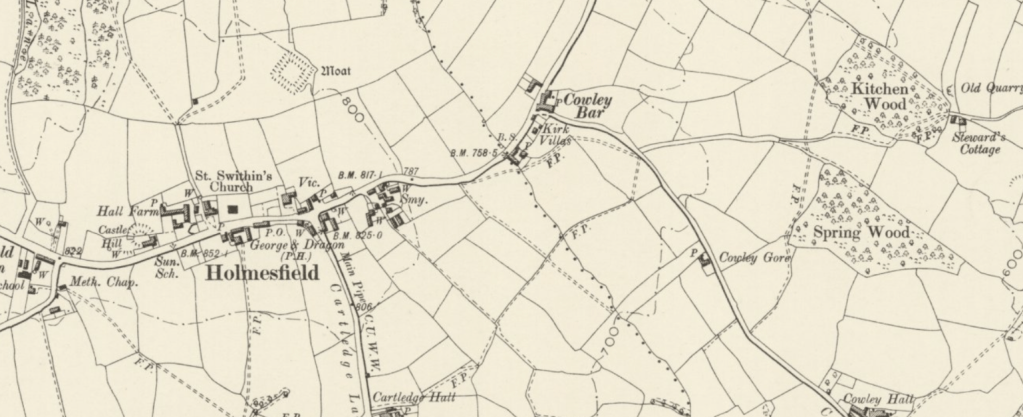
Luke was born in 1818, the tenth child of John and Mary Pearson[1]. By the time he was three, his mother had borne twins both of whom sadly died in infancy[2]. The family lived in the Cordwell Valley, two miles from Holmesfield, in an area known simply as ‘Bank’, rising steeply via Fox Lane. Holmesfield itself was a small village described in one source as being “highly respectable” with “several very genteel habitations”[3]. Nestled on the eastern edge of the Peak District, the area is surrounded by rolling farmland, wooded valleys, and distant moors.
By 1841, the Pearsons were farming in nearby Cowley Gore, with Luke as the only child remaining at home[4]. He worked as a farm servant alongside his father until John’s death in 1845[5]. Luke stayed on to help his widowed mother on the smallholding[6] but after her death in 1854 he began to chart a new course[7]. He became the tenant of Southwood Farm on Hill Top in Dronfield[8], a well-equipped mixed farm with horses, cattle, pigs and even hives of bees. This was not subsistence farming but a relatively comfortable domestic life with a degree of self-sufficiency and modest prosperity.
Yet by his late 30s, Luke remained unmarried and was perhaps restless. His father had fathered eight children by that age; Luke was still turning the soil alone. One can imagine him at the close of a long summer day in 1856, leaning on his plough, watching the sun dip behind Long Acre Wood, wondering if the life he knew was all there was.

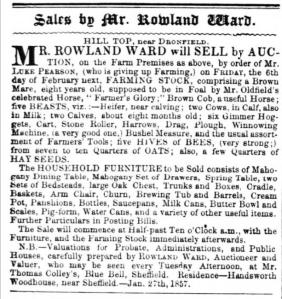
Then in 1857 Luke made a dramatic change[9]: he gave up farming, auctioned off his livestock, equipment and furniture, and moved to Cowley Bar to establish a grocer’s shop.
Cowley Bar was a hamlet on a branch of the Sheffield–Derby turnpike, near a tollgate through which coaches and carts frequently passed. The close proximity of the tollgate may have introduced Luke to toll collection as a line of work—an experience that would soon prove relevant. It was also at Cowley Bar that Luke employed a young servant named Ann Sharman[10]. Though not yet married, Luke and Ann’s relationship became strong, and the arrangement suggests a close domestic partnership well before formal vows.
Ann was born in 1833 in Kirklington, Nottinghamshire, the illegitimate daughter of Isabella Sharman of Sutton cum Duckmanton[11]. Her baptism record did not name a father, and she grew up in Edingley, where her mother had married Thomas Foster in 1835[12]. Though she retained the surname Sharman, Ann lived as part of the Foster household, alongside her half-siblings. By 1851, she worked as a framework knitter, a common but gruelling trade in Nottinghamshire, likely taught to her by her stepfather.[13]
In 1850, Ann’s name briefly appeared in the local newspaper after a man named Thomas Linney was charged with assaulting her in Edingley[14]. Though the case was settled with costs paid, it’s a rare glimpse into the risks faced by working-class women and Ann’s willingness to seek justice. In 1861, Luke also found himself in the news after he was involved in a coach accident near the Cowley Bar tollgate. He was riding on George Allen’s coach when it collided with a rival driven by John Godber. As a witness, Luke testified that he had warned Allen to stop as they neared the bar, but Allen drove on, leading to the fatal injury of a horse. The court ruled in Godber’s favour, the incident underlining Luke’s presence as a trusted local figure.[15]
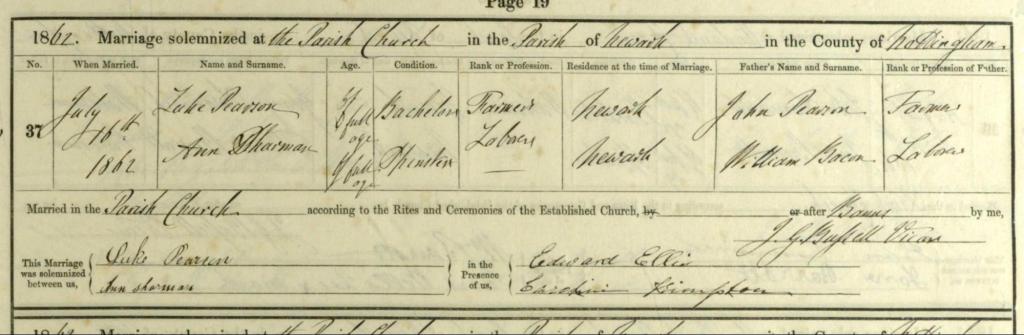
In July 1862, Luke and Ann married in Newark, both giving their residence as the town and Luke’s occupation as a farm labourer[16]. The shift suggests they had recently left Cowley Bar, possibly in search of seasonal work or a fresh start closer to Ann’s home county. Their decision to marry in Newark, away from Holmesfield, may have been motivated by convenience, privacy, or Ann’s family ties in nearby Edingley.
By the following spring, the couple had moved again—this time to Hockerton, a small village just north of Southwell—where their first daughter Mary Ann was born in April 1863[17]. Luke was now employed as a tollgate collector, a position that often came with tied accommodation and steady, if modest, income. His earlier familiarity with tollgates in Cowley Bar likely helped him secure the post.
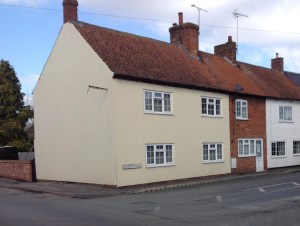
In 1867, Luke reappears in the records as the occupier of a grocer’s shop, beerhouse and bakehouse in Edingley—Ann’s home village[18]. Their cottage was next door to Ann’s adoptive father, Thomas Foster. This move marked a return to shopkeeping, but with added stability, now rooted in a community they likely knew well. It may have been a natural next step for a couple seeking to establish themselves after years of moving between roles and locations. Whether through family connections, opportunity, or local need, Edingley became their long-term home and it was here that more children followed: Ellen Jane, Annie Elizabeth, and finally their only son William in 1874—when Luke was 56.[19]
Running a beerhouse brought its own challenges. In 1869, new licensing laws required licensees to meet strict standards — no disorder, drunkenness, or gambling — or risk losing their license at the annual ‘brewster sessions’[20]. Luke would have had to tread carefully. Notorious locals like cottager John Davidson, the so-called “Edingley Giant,” had often been charged with public drunkenness and indecency. Davidson died in 1869, perhaps to Luke’s quiet relief[21].
Tragedy struck in 1877 when Ann died of pneumonia aged just 44 years old.[22] Left with three young children, Luke likely relied heavily on Mary Ann, then 14, to help run the household and business. By 1881, she had married and moved next door with her own baby, and Luke continued to run the shop with Ellen Jane and William.[23]
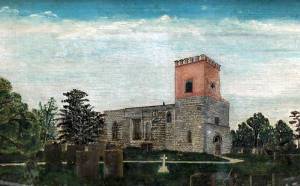
Luke’s later life in Edingley was not without its dramas. In April 1881, he gave evidence in a burglary case after a man broke into the home of local shoemaker John Hallam. From his premises nearby, Luke had seen the suspect near the toll road and later observed him vanishing behind Hallam’s house, confirming key details in the prosecution’s case[24]. Just a few years later, in 1884, he himself was the victim of petty theft when a local youth stole a mustard pot containing money from his shop[25]. Then in 1893, a drunk labourer stole Luke’s jacket from the pub while under the influence[26]. These minor episodes, scattered across more than a decade, show Luke not only as a long-serving grocer and beerhouse keeper, but as someone whose premises stood at the heart of village life — a place where the ordinary and the unruly alike passed through.
Luke never remarried. He remained a widower and continued as a grocer and publican into his seventies.[27] He died in 1895 of acute gastritis at age 77[28]. His estate was valued at £62[29]—modest but a testament to a lifetime of steady effort—and his son William succeeded him in running the business, continuing the Pearson presence in Edingley for at least another generation.[30]
Luke and Ann’s lives, rooted in farming and framework knitting, were transformed by perseverance into one of enterprise and community. He abandoned a familiar life for something new; she endured and overcame hardship; together they built a legacy of self-reliance and community that continued through their children.
[1] Baptism record of Luke Pearson, Holmesfield, 1818
[2] Baptism/burial records for Caroline and Selby Pearson, Holmesfield, 1822
[3] Pigot and Co’s Commercial Directory for Derbyshire, 1835
[4] 1841 Census entry for household of John Pearson, Cowley, Dronfield, HO107/1951/1
[5] Burial record for John Pearson, Holmesfield, 1845
[6] 1851 Census entry for household of Mary Pearson, Cowley Gore, Dronfield, HO107/2148
[7] Pearson/Cope family tree in possession of Valerie Pearson
[8] Derbyshire Courier, 14 March 1857
[9] Adverts in Sheffield Independent and Derbyshire Courier from 31 Jan and 14 Mar 1857 respectively
[10] 1861 Census entry for household of Luke Pearson, Cowley Bar, Dronfield, RG9/2537
[11] Transcription of baptism record of Ann Sharman, Kirklington, 1833
[12] 1841 Census entry for household of Thomas Foster, Edingley, HO107/865/17
[13] 1851 Census entry for household of Thomas Foster, Edingley, HO107/2134
[14] Nottingham Review, 5 July 1850
[15] Derbyshire Courier, 23 Feb 1861
[16] Marriage certificate of Luke Pearson and Ann Sharman, Newark, 1862
[17] Birth certificate of Mary Ann Pearson, Southwell, 1863
[18] Nottinghamshire Guardian, 14 Jun 1867; 1871 Census entry for household of Luke Pearson, Edingley, RG10/3532
[19] 1881 Census entry for household of Luke Pearson, Edingley, RG11/3368
[20] Wine and Beerhouse Act, 1869
[21] Various articles in Nottinghamshire Guardian, 1861-1869
[22] Death certificate of Ann Pearson, Southwell, 1877
[23] 1881 census
[24] Nottinghamshire Guardian, 8 July 1881
[25] Nottinghamshire Guardian, 7 Mar 1884
[26] Newark Advertiser, 9 Aug 1893
[27] 1891 Census entry for household of Luke Pearson, Edingley, RG12/2707
[28] Death certificate of Luke Pearson, Southwell, 1895
[29] Grant of Probate for Luke Pearson, County of Nottingham, 14 Nov 1895
[30] Newark Advertiser, 29 Apr 1896

 We Are The Balls
Thank you once again for the very informative history of our family
I wonder if you could please help me with the address of Rose Cottage in Helpringham
Kindest regards Linda and Graham Ball
>
LikeLike
Thank you Graham. This story is actually from my mother’s side but will have more from the Balls soon!
LikeLike
fantastic. I have so enjoyed reading this
Thank you
Sarah Smithurst
LikeLike
Thanks Sarah. You may also like my post about Luke’s son (your great-grandfather), William: https://wearetheballs.uk/2022/01/12/working-class-boy-made-good/
LikeLike