George Cuthbertson (abt 1829–1912) and Jessie Wilson (abt 1829-1891)
In the dark, George gripped the sleepers with both hands and pulled, and kept pulling until they gave.
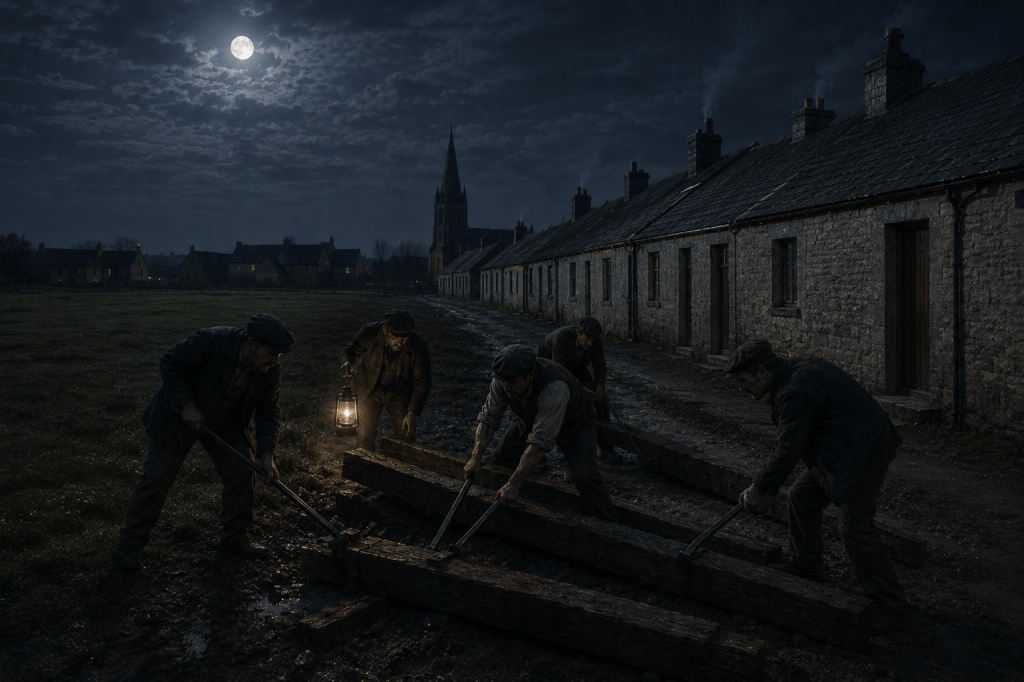
The Common Green at Stonehouse had always belonged to the people who lived around it, used for washing, for bleaching linen in the sun, for drying what had been washed. Then someone fenced it, and a barricade of railway sleepers went up along the street, and the village was angry. Sleepers are heavy, meant to stay where they’re laid, and night after night, headed by George, his neighbours pulled them down anyway, for as long as it took. Put up again by day, torn down again by dark, until whoever was building it gave up. “The Common Green was left to the people of Stonehouse,” his nephew James recalled.1
George Cuthbertson was a handloom weaver, and by his nephew’s account a quiet, unassuming one. He was also, when it mattered, someone who organised his neighbours to dismantle a fence in the dark. Both things were true of him, and the rest of his life bears that out.
Roots and upbringing
George was born around 1829, most probably in Lesmahagow, Lanarkshire, the eldest son of John Cuthbertson and Rachel Ballantyne.2 By the time he was eleven the family had settled in King Street, Stonehouse, and he was already at work: the 1841 census lists John as a silk weaver and George a cotton weaver in a household where the loom was both livelihood and inheritance.3 Like his father, George would make his living at the weaving machine well into old age. And he would never leave Stonehouse.
The Cuthbertsons were a weaving family rooted in the upper Clyde valley. John, born in 1806, had worked in his younger years as a spadesman to local farmers, digging ground a plough couldn’t reach, and as a driver of a brewer’s cart between Lanark and Clydeside. In later life he was remembered as a great reader who sat up with a candle into the small hours, and a man who, when weaving work required it, thought nothing of walking to Glasgow and back for a web of yarn, forty miles each way, carrying the material home on his back. His wife Rachel Ballantyne, born in 1809, was by the same account devoutly religious and self-possessed, her life marked by the hardships common to the weaving community of those years.4,5,6
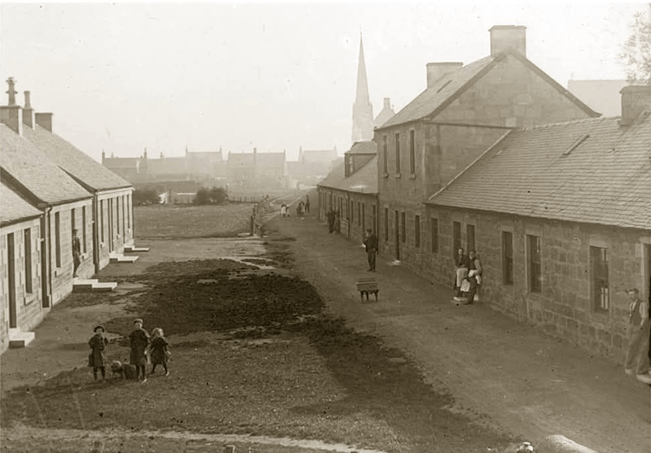
Stonehouse sat in Clydesdale, rolling farmland along the river valley with orchards on its lower slopes, its weaving villages set among the fields rather than apart from them, close enough to Glasgow for a determined man to walk there and back in a day, far enough to keep their own trades and their own character. It was a village at the height of its prosperity when George grew up in it, developed through the eighteenth century as a community of household weavers, producing first linen, then cotton, and by the 1830s, its peak years, silk: scarves, handkerchiefs and fine goods made largely for export, including to officers of the Indian Army. At its height around 1831 some six hundred weavers worked in the village, many of them owner-occupiers of the one-storey sandstone cottages whose layout, a weaving shop to one side of the front door and living quarters to the other, a loft reached by a heavy wooden ladder, a small garden behind, would have been entirely familiar to any Cuthbertson of that generation.7,8
Marriage and family
Janet Wilson was born around 1828, the daughter of Robert Wilson, a coal miner, and Mary Wilson née Barrie. Before she was twenty she had already borne a daughter, Mary, around 1849 in Carluke. Janet doesn’t appear in the 1851 census under any household so far traced, likely in service at the time, and the infant Mary was raised instead by Robert and Mary, recorded as their granddaughter, an arrangement common enough when no father had been named.9
On 27 November 1853, the banns were proclaimed at Carluke for the marriage of George Cuthbertson, “of the parish of Stonehouse,” and Janet Wilson, “of this parish.” She was known within the family as Jessie though the Old Parish Register recorded her formally as Janet. That she was a Carluke parishioner likely explains why the marriage took place there rather than in Stonehouse.10,11,12
George and Jessie would have nine children between approximately 1854 and 1871, all born in Stonehouse. Two died in childhood: George Junior, born 1859, survived less than a year; John, the first of that name, born 1856, lived to the age of eight before dying in 1864.
The remaining seven, Jessie, Robert, a second son also named George, James, John, David and Jane (known as Jeanie), grew up in a household increasingly centred on Green Street, where George would remain for the rest of his life.
A cottage like theirs meant one main room doing the work of three, kitchen, living room and bedroom together, with a set-in bed or two against the wall and the loft above for whoever didn’t fit. A household with so many children, even as some moved on, would have filled every inch of it.
By 1881 George and Jessie were at number 9 Green Street — a household still full despite some children grown and gone. Three of George’s sons, James, John and David, seventeen, fourteen and twelve, were all working as silk weavers alongside their father, while the youngest, Jane, ten, remained at school. The weaving trade had held the family for at least three generations by then, and the sons had entered it young, as George himself had, forty years before. A short distance away, at number 7, lived the eldest of their children, also named Jessie, married by then to a silk weaver named John Brown.13,14
The tie between Jessie and her first daughter was never severed. Mary turns up as a visitor in George and Jessie’s home on the 1861 census, and by 1871 was living there outright, recorded as their daughter and working as a domestic servant, though still carrying her own surname, Wilson, rather than Cuthbertson. That same year, marrying James Hamilton in Stonehouse, she named her mother without evasion: Janet Cuthbertson, formerly Wilson. No father was recorded. Whatever it cost Jessie to give up a daughter as a girl, the record shows her taking that daughter back as a woman. By 1881 Mary and James were settled in Glasgow with three children of their own. They had named their first daughter Jessie, after the mother who had once given her away, and then taken her back.9
The handloom weaver’s world
The process by which George earned his living was intricate and unrelenting. A weaver obtained his yarn from one of the agents in the village, at its height Stonehouse had three, collected in a paper bag along with a pattern card if the design had changed. His first journey was to the beamer, who wound the yarn onto the wooden beam belonging to the client. The weaver then carried the beam home, mounted it at the back of the loom, and engaged a twister, a quick-fingered specialist, to tie the new warp ends to the remnant of the previous web at extraordinary speed. Only then did the main work begin: hours at the shuttle, back and forth across the Jacquard machine, arms, hands and feet moving in a rhythm that had to hold steady for as long as the light lasted, and broke for nothing, since a missed thread meant unpicking work already done. It was work done sitting, in a cottage that would have been cold in winter and loud with the clack of the loom from before dawn most days of George’s working life. The loom shop itself took a toll on the body as much as the trade took on the eyes. Floors were bare earth, ventilation an afterthought, the wood of the frame often green and damp, and the air thick with oil and fibre from the work itself. A twelve-hour day in a shop like that, winter and summer alike, would have worn harder on a man in his sixties and seventies than on the boy who’d started at the loom decades before.15
The censuses trace George’s adaptation through this world. He was a cotton weaver in 1841 and 1851, a weaver of mixed fabrics by 1861, and a silk weaver by 1871, a shift that reflected Stonehouse’s own specialisation as the cotton trade mechanised and the village’s handloom community found its last competitive ground in the finer, more intricate silk work that power looms could not easily replicate. He was still a silk weaver in 1881 and 1891, working from 9 Green Street at an age when most men would have long since left the loom. But the industry was entering its final years. In August 1892 a local report recorded that it had proved impossible to establish a co-operative manufacturing company in Stonehouse, that many hands were already out of work, and that “the outlook for the weavers is at present very dark.” In later years George shifted again, weaving wool, the last refuge of the handloom trade, still at his loom at seventy-two: a man in his eighth decade doing work built for younger hands and eyes, because it was the only work he had.16,17,18
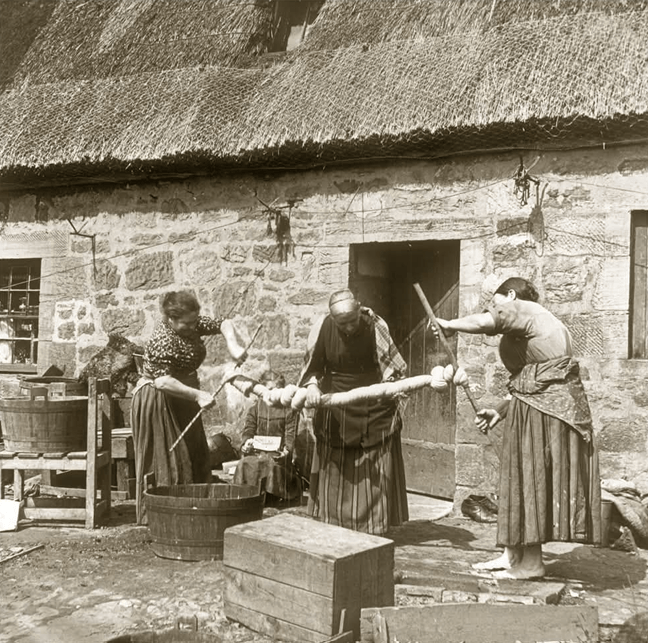
Jessie herself was no stranger to the trade she’d married into: the 1861 census lists her as a weft winder, winding the crossing thread onto the pirns that fed George’s shuttle. Her own working life would have run alongside the street itself as much as the loom shop: the drying green at the top of Green Street, with its communal well, and the washhouses behind the row, coal-fired boilers, mangles, scrubbing boards, clothes lifted from the boil with long wooden tongs, were where the women of the street did the week’s heaviest work, and very likely its best talking.19
A man of principle
It is George’s nephew James, son of his brother James, born in Stonehouse in 1885, who preserves the clearest portrait of the man beyond the loom. In a memoir written in later life, James set down what he had heard round the fireside as a boy:
“That George had courage there is no doubt, for although not an elected member, he walked into a Parish Council meeting and sat down. When asked what he wanted, he said he was there to hear the meeting. For this he was summoned to Hamilton by the Council. The judge who tried him gave the Council ‘over the coals’ and said ‘The man has a perfect right as a ratepayer to enter and hear the Council’. These things probably made him popular, for he stood as a Councillor later and topped the poll.”1
James names the body as the Parish Council, but the documentary record points to the Stonehouse School Board, one of the locally elected bodies set up under the 1872 Education Act to run parish schools. In July 1881 George and a William Loudon were taken to Hamilton Sheriff Court by the Board, which wanted them barred from its meetings altogether. At issue was whether an ordinary ratepayer, not standing for election, had any right to be there at all. The Education Department found squarely in George and Loudon’s favour. George was elected to the Board itself not long after, sitting on the Parochial Board too by 1886, the body that administered poor relief in the parish.20,21,22
It was, in its way, an entirely characteristic dispute for a Stonehouse weaver to pick. The trade had a reputation locally for hard political opinion and harder scrutiny of anyone holding public money, and George’s insistence on being present to see it spent was less an oddity than a habit of the village he’d grown up in.
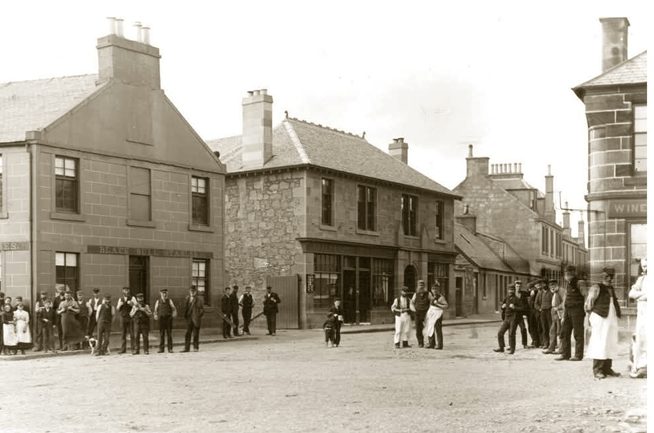
Between the Common Green and the Sheriff Court, a pattern holds: George’s response to an authority acting without the community’s consent was the same each time, to assert the right, bear the cost, and persist. The “quiet unassuming” weaver of James’s memory was also, when civic principle was at stake, a man who would walk into a room uninvited and state his business.
Loss and the long decline of a trade
George and Jessie had been married for nearly thirty-eight years when she died at Green Street on 28 December 1891, ill for ten days with heart disease and a further five with pulmonary congestion, aged sixty-three. George was present at her death and registered it himself the following day. The census taken eight months earlier, in April, had shown a still-substantial household: George and Jessie, with James and Jane at home, and John possibly next door with his wife Maria and their two young children. By the time of the 1901 census, all of that had gone. George was alone at 9 Green Street, a widower, still weaving, with most of his children dispersed across the industrial central belt.23,24
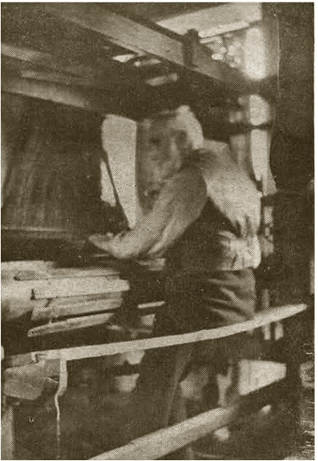
The trade itself had loosened its hold on the next generation even where the family hadn’t. John kept to trades adjacent to weaving without staying at the loom: a cotton yarn beamer in Stonehouse in 1891, a cloth inspector in Paisley by 1901. George went further, leaving textiles altogether for a carter’s work in Glasgow. Robert had gone east before either brother, into the Midlothian mills and later a beaming trade of his own in Glasgow’s Calton district. James is the least certain of the five: a man of that name and rough age appears as a cloth inspector in Cathcart by 1910, perhaps the same man who emigrated to New York in 1922. David, already at the loom alongside his father and brothers in 1881, left Stonehouse in time too, settling in Milton, Glasgow.25,26,27,28,29
His eldest daughter Jessie, married to John Brown and settled two doors down at number 7 Green Street, died childless in 1903, aged around forty-eight, after nearly thirty years of marriage. John remained at number 7, a furniture dealer by then rather than the silk weaver he’d been. George’s youngest daughter Jeanie, who had been working as a servant at Kirkwood House in Coatbridge, married Alexander McDonald, a coachman, at Glasgow in March 1904, and left Stonehouse for the Glasgow area. Within eighteen months George had buried his eldest daughter and watched his youngest leave. He was in his mid-seventies, and alone in the house on Green Street.30,31
Final years
By 1911 George was still at 9 Green Street, a widower, eighty-one years old. He had retired at some point in the previous decade and the house had gone quiet in a way it hadn’t been in sixty years: no shuttle, no yarn to collect, the same address he had occupied for at least thirty years but a different life inside it. Next door at number 7 was his widowed son-in-law John Brown, fifty-nine. It is a reasonable inference that Brown, who had lived alongside the Cuthbertsons for the better part of three decades, was George’s closest daily company in those years.32
George died there on 28 September 1912, after approximately five months of illness from acute desquamative hepatitis, a term doctors of the period used for a serious wasting of the liver, marked by jaundice and a slow physical decline rather than a sudden collapse. He was eighty-three years old. His daughter Jeanie McDonald travelled from the Glasgow area to register the death two days later. No burial record has yet been located, but Stonehouse Parish Church or Avondale Old Parish are the likely place of interment; whether he was buried in the same grave as Jessie, who had died twenty-one years before, is not yet known.33
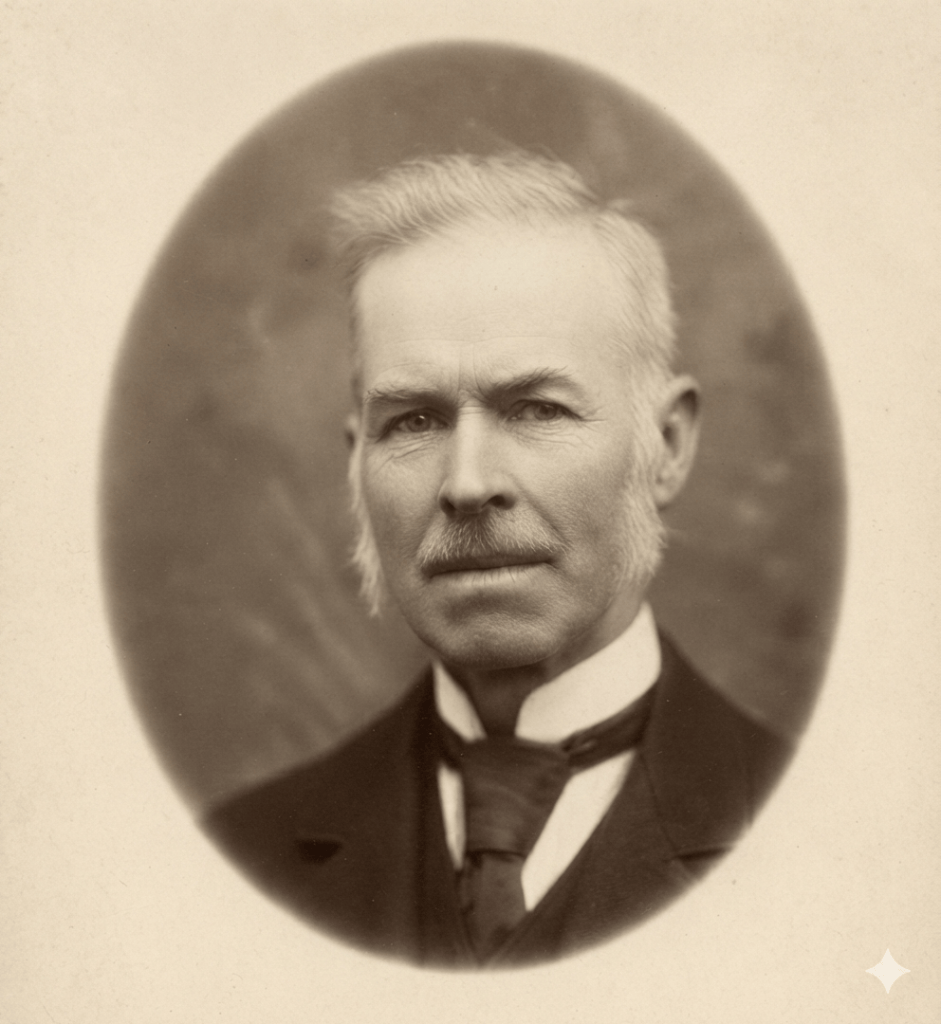
Closing
The trade that shaped George moved on rather than ending. His son David carried a version of it to Glasgow: cloth inspector and later pattern checker, judging cloth rather than weaving it, in a city his father never had reason to leave Stonehouse for.34 The eye George had spent sixty years training at the shuttle became, one generation on, a different kind of eye altogether, standing over other men’s work on a factory floor rather than his own at a cottage loom.
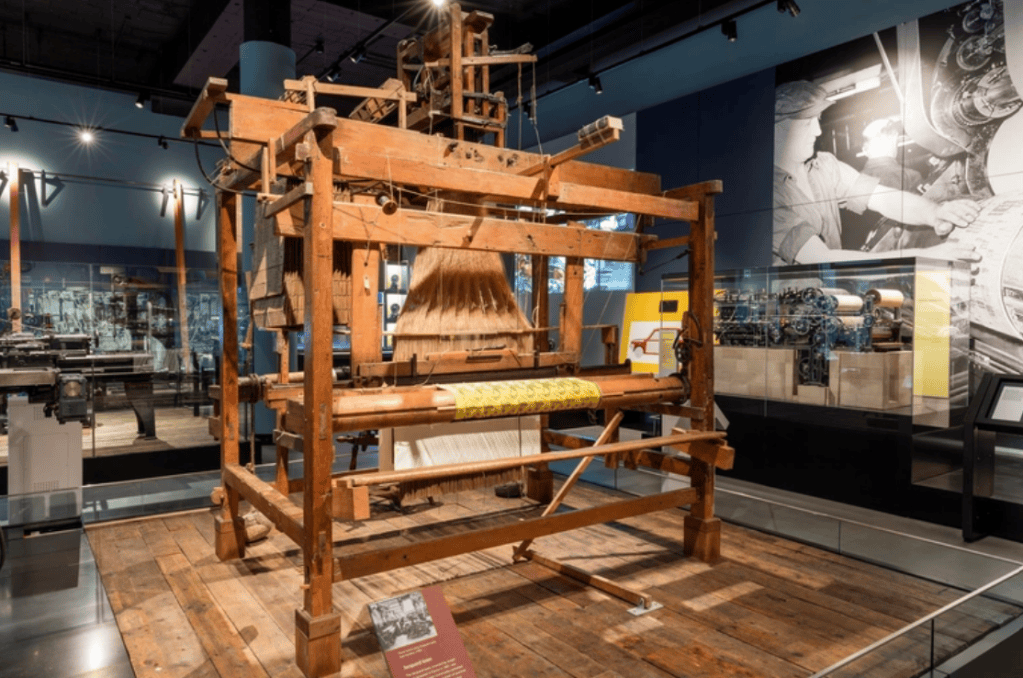
What survived George Cuthbertson was not the loom itself. Handloom weaving in Stonehouse ended within a generation of his death; Robert and James Hamilton of Cam’nethan Street, the last handloom weavers in Lanarkshire, wove their final web in 1939, and their loom now sits in a museum case in Edinburgh.35 What survived was closer to the thing James remembered: a man who, told he had no business being somewhere, went and stood there anyway. It surfaced once at a fence line and once in a courtroom, and in the one case we have a full record of, he was vindicated by the men sent to judge him. It was enough, in James’s telling, to get him elected twice over by people who’d watched him do it.
Notes
- James Cuthbertson memoir (see note 4). Quotations reproduced as written in the original. ↩ ↩
- Birth year and birthplace unconfirmed; no OPR baptism entry located. Age at death (83) implies b. abt 1829; 1901 and 1911 censuses give Lesmahagow, earlier censuses give Stonehouse. [OPR search unsuccessful, Lesmahagow and Stonehouse, 1828–1832.] ↩
- 1841 Scotland Census, Stonehouse, Lanarkshire, household of John Cuthbertson, King Street; ScotlandsPeople; GRO ref 656/4/37. ↩
- James Cuthbertson (b. 1 May 1885, Stonehouse), “Tales and Incidents of Family History,” unpublished memoir. Cited throughout for recollections of John and Rachel Cuthbertson and their son George. James was the son of James Cuthbertson (b. 1854) and Elizabeth Carruthers — George’s nephew. ↩
- James Cuthbertson memoir (see note 4). ↩
- James Cuthbertson memoir (see note 4). Rachel Ballantyne’s birth, Old Parish Register, Dalserf, Lanarkshire, 10 December 1809, OPR ref 638/10/116. ↩
- “Stonehouse Weavers,” sorbie.net; “Occupations — Weaving,” StonehouseOnline.org.uk. Cited for context on the Stonehouse silk trade and its Indian Army market. ↩
- sorbie.net (see note 7), citing a photograph of 33 Green Street and a cottage sketch plan by Tom Sorbie; StonehouseOnline.org.uk (see note 7). Secondary narrative sources. ↩
- Mary Wilson (b. abt 1848, Carluke): 1861 Scotland Census, Stonehouse; 1871 Scotland Census, 1 Green Street, Stonehouse, household of George Cuthbertson (domestic servant). Marriage of Mary Wilson and James Hamilton: Statutory Register of Marriages, Stonehouse, 30 June 1871; mother recorded as Janet Cuthbertson, formerly Wilson; father recorded as Unknown. 1881 Scotland Census, Glasgow, household of James Hamilton, GRO ref 644/2 8/2. ↩ ↩
- Proclamation of banns, George Cuthbertson and Janet Wilson: Old Parish Register, Carluke, Lanarkshire, 27 November 1853; ScotlandsPeople, OPR ref 629/0030/0323. ↩
- Death certificate of Jessie Cuthbertson (née Wilson): Statutory Register of Deaths, Stonehouse, 29 December 1891 (name recorded as “Jessie”), GRO ref 656/00/0055. Marriage of Jeanie Cuthbertson and Alexander McDonald: Statutory Register of Marriages, Glasgow, 18 March 1904 (mother named as “Jessie Wilson”), GRO ref 644/8/72. ↩
- Death certificate of Jessie Cuthbertson (see note 11): father Robert Wilson, coal miner (deceased); mother Mary Wilson née Barrie (deceased). Birth year abt 1828 inferred from age 63 at death. ↩
- Deaths of John Cuthbertson (i), 1864, and George Cuthbertson Junior, 1860: Statutory Register of Deaths. GRO refs Stonehouse, 656/50 and 656/4. ↩
- 1881 Scotland Census, Stonehouse, 9 Green Street, household of George Cuthbertson; GRO ref vol. 656, enum. dist. 1, p. 19. Jessie Brown and John Brown, 7 Green Street: 1881 Scotland Census, GRO ref 656/1/19. ↩ ↩
- sorbie.net (see note 7): description of the beaming, twisting and weaving process, drawn from recollections of 1875–1900. ↩
- Occupational progression from Scotland census records: 1841 (see note 3); 1851, 25 Townhead Street, Stonehouse; 1861, 72 New Street, Stonehouse (mixed fabrics weaver); 1871, 1 Green Street, Stonehouse (silk weaver); 1881 (see note 14), silk weaver. ↩
- “The Stonehouse Silk Industry,” newspaper report, August 1892, reproduced in StonehouseOnline.org.uk (see note 7). Original newspaper Hamilton Advertiser. ↩
- 1901 Scotland Census, Stonehouse, 9 Green Street, household of George Cuthbertson; GRO ref 656/1/11. Occupation: handloom weaver (wool). Birthplace: Lesmahagow. ↩
- 1861 Scotland Census, Stonehouse, household of George Cuthbertson (Jessie Cuthbertson, occupation weft winder; see note 16). Washhouse and drying-green detail: sorbie.net (see note 7). ↩
- Stirling Observer, 23 July 1881, “Extraordinary Application by a School Board”. ↩
- Hamilton Advertiser, 2 September 1882, “Stonehouse School Board Affairs”. ↩
- Hamilton Advertiser, 1882-1886 (six clippings). 26 Aug 1882, 12 July 1884, 4 Apr 1885, 11 July 1885, 10 July 1886. ↩
- Death certificate of Jessie Cuthbertson (see note 11): cause of death heart disease (10 days) and pulmonary congestion (5 days), certified by Alex H. McLean MB CM; informant George Cuthbertson, present at death; registered 29 December 1891. ↩
- 1891 Scotland Census, Stonehouse, household of George Cuthbertson; GRO ref 656/1/16. ↩
- Marriage of Robert Cuthbertson and Margaret Paterson: Statutory Register of Marriages, Lasswade, 1883. [Father’s name on certificate unconfirmed.] Robert Cuthbertson, merino yarn beamer, Glasgow Calton: 1901 Scotland Census. ↩
- Marriage of John Cuthbertson and Maria Hair: Statutory Register of Marriages, Stonehouse, 1889. 1891 Scotland Census, Stonehouse, household of John Cuthbertson, GRO ref 656/1/16. 1901 Scotland Census, Paisley, household of John Cuthbertson. ↩
- Marriage of George Cuthbertson and Marion MacKenzie: Statutory Register of Marriages, Pollokshaws, 1888. 1891 Scotland Census, Glasgow Barony, household of George Cuthbertson. ↩
- David Cuthbertson (b. 24 June 1868, Stonehouse): Statutory Register of Births, Stonehouse, registered 14 July 1868. ↩
- Possible identification of James Cuthbertson as cloth inspector, Cathcart marriage 1910, and passenger to New York 1922: unverified working hypothesis; father’s name on the 1910 marriage certificate not yet confirmed. ↩
- Death of Jessie Brown (née Cuthbertson): Statutory Register of Deaths, Stonehouse, 1903, GRO ref 656/45. Age approx. 48, inferred from birth year abt 1854–1855. ↩
- Marriage of Jeanie Cuthbertson and Alexander McDonald: Statutory Register of Marriages, Glasgow, 18 March 1904, 69 Springbank Street (see note 11). Both parties resident at Kirkwood House, Coatbridge; Jeanie Cuthbertson listed as servant there, 1901 Scotland Census. ↩
- 1911 Scotland Census, Stonehouse, 9 Green Street, household of George Cuthbertson. Age 81, widower, retired handloom weaver, birthplace Lesmahagow. John Brown, widower, 59, furniture dealer, No. 7 Green Street: same census. ↩
- Death of George Cuthbertson: Statutory Register of Deaths, Stonehouse, 28 September 1912, registered 30 September 1912. Age 83; cause acute desquamative hepatitis, approx. 5 months; widower of Jessie Wilson; informant Jeanie McDonald (daughter). GRO ref 656/00/0038. ↩
- Marriage of David Cuthbertson and Marion Fleming Ford: Statutory Register of Marriages, Stonehouse, 25 June 1887 (occupation: handloom weaver). 1901 Scotland Census, Glasgow Kelvinside, household of David Cuthbertson (occupation: cloth inspector). Ref 644/8 62/ 23. Birth of David Cuthbertson (son): Statutory Register of Births, Milton, Glasgow, 22 April 1902 (father’s occupation: weaving factory pattern checker). ↩
- StonehouseOnline.org.uk and sorbie.net (see note 7): Robert and James Hamilton of Cam’nethan Street, the last working handloom weavers in Lanarkshire, wove their final web in 1939; loom now in the Royal Scottish Museum, Edinburgh. ↩
 We Are The Balls